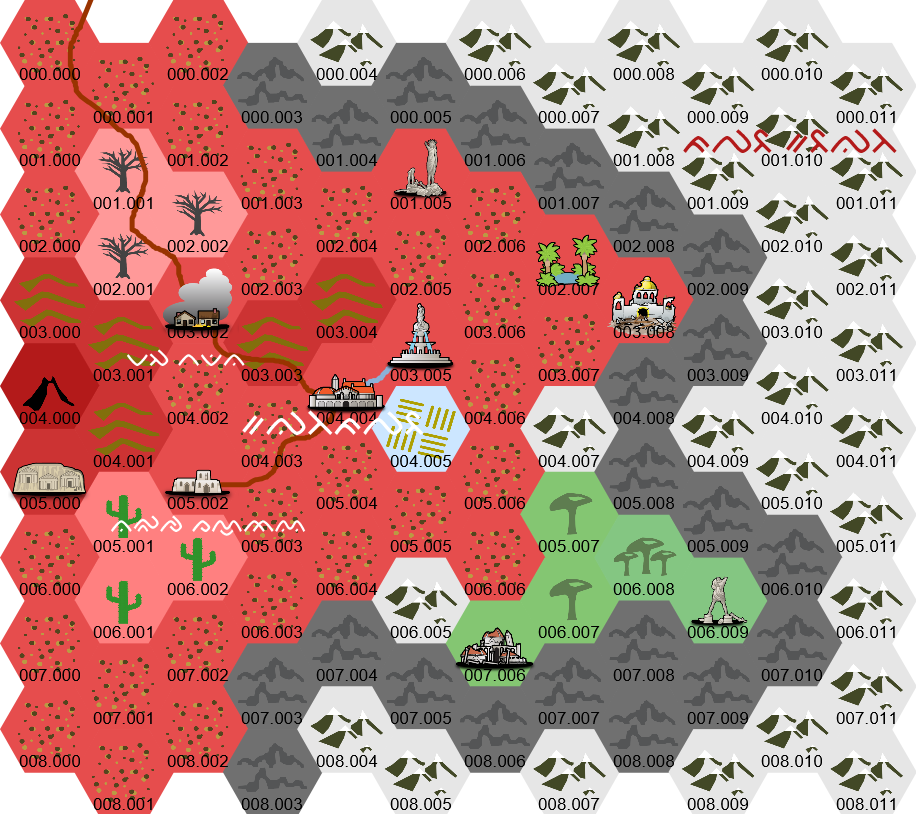
The above is a map of the Mlejnas region of Tlön - a region which properly understood is "the region around the custodianship of the city of Mlej," not a geographic area. Each hex represents about a day's travel.
An experimental widget thing in lieu of a proper encounter table
I'm convinced the format of
this thing has potential, but didn't have the time to really make it shine. In the future I can imagine myself making this the
only way Tlön or some other setting is presented.
Settlements too small to picture on the map
Most people are free peasants, and live most of their lives in very small thorps and hamlets - generally just an extended family living in a cluster of households; there they grow maize, squash, and beans, with goats and ostriches to forage and hearth coyotes to guard them.
In the past, there was an elaborate system of canals that fed larger settlements across the region. These have fallen into disrepair - the newer and active settlements are based where dowsers can find a well, or where there's otherwise favorable geography (typically placing buildings on a mesa overlooking a basin where some water arrives.) The old ghost towns have been picked dry of any miracles or useful materials that are easy to grab, but some are still available. At the height of the empire automated home security systems were built into many upper-class houses; their residents are gone, but the solar paneling and genius loci of the houses remain. These ghost towns are also often frequently the site of healing temples, magician lodges, bandit hideouts - all in all, a compendia of things best forgotten.
Mlej, a major settlement
Mlej (4.4) is a large city which is no longer quite as large as it used to be - whole sections of the city are uninhabited, typically those regarded as inauspicious or ghost-haunted. (The most elaborate and ancient palaces are not home to the city's senatorial families but to even more elaborate versions of the home security systems that can be found in the ghost towns.) Nevertheless, Mjelnas has done well for itself. Thanks to the large water pump system at 3.5, it is able to support the heavy irrigation fields at 4.5 and, through this, a significant surplus population, part of which is used to finance and buy off settlements elsewhere, and part of which is used for the city's distractions and carnival culture.
Since a significant portion of the regional population lives in settlements too small to mark on the map - just a few households comprising an extended family; little thorps of a few households supported by squash, beans, and ocasional petty drills or subventions of water from the city proper - and marriage is exogamous, the desire for young folk to mingle and eventually marry is in large part satisfied by the central hub of Mlej. With a variety of cultural metaphors connecting the beginning and end of life to midnight, this period - generally from late teens to early twenties, somewhere between an Amish rumpsringa and an American adolescence - is generally known as the "morning" of life. Youth living out their morning in Mlej are expected to serve some years of service to the state - in the army, or engineering corps, or some other institution that serves the city and its ruling families. (Unlike the American college experience, there is little expectation that these young people will be learning skills that will be especially useful in their later lives, which they can after all learn better from their parents and aunts and uncles back on the farm, or high culture, which is a status marker of the senatorial families and their attendants. It is rather a corvee of able-bodied labor with a carnival atmosphere. The most important "educational" point, for all but a minority of them, is to be impressed by the wealth and generosity of the ruling elite.) The immediate effect of all of this is that Mlej is dispropotionately filled with people in the most violent, horny, inebriated, and uncertain stage of life, a fact that effects every aspect of its daily life. When the fun is over and adulthood begins, the couples typically go to the bride's village, which pays the groom's village for the loss of their son.
While the peasants working bean agriculture throughout the countryside are free, those working the paddy fields in the immediate shadow of Mlej are debt slaves. As elsewhere across the old empire of Tlon, Mlenjas has an Office of the Voice of Slaves, which protects their legal rights - that accurate ledgers are kept of their debts, that their days of service are rewarded according to a certain kept table, that families are not broken apart, that physical punishments are kept within certain limits, that they may participate in certain religious festivals and obligations, and so on. (Needless to say, the Office of the Voice of Slaves is effectively owned by the same families that own every other major institution in Mlej - including the slaves and the irrigation fields where they work.) Debt slavery is not formally hereditary, and there's enough influx and outflux of membership that it's not understood as a racialized institution, but multigenerational slavery is extremely common. The city is perfectly aware of its dependence on the institution, and schedules of fines and rates of interest are regularly adjusted to ensure that the population of debt slaves remains large enough to provide the rice that feeds it. Some heresiarchs suggest that the "morning of life" and its period of service could be extended to serve this function instead, but this is a minority opinion.
The Jangrs
North Jangr (3.2) and South Jangrs (5.2) were and are, respectively, subordinate towns of Mlej - proper towns, too; with many families and their own (but subordinate) governments. This was and is, respectively, possible because of the valleys of cactus which grow here, thick as jungles, based on their ability to grow deep into some unknown aquifer. This is also why North Jangr was done away with. The city-region of Oxlunas and its allied nomadic people, the stirrups-and-emu equipped Nlanx, put the whole northern region to torch and axe on the grounds that the unknown aquifer in question was their own.
From the perspective of imperial law, Oxlu's case is excellent. A legation of philosopher-engineers, dowsers, and poet-lawyers was sent to raise protest, seek recompensation, and propose a variety of neutral arbiters - only one of whom was the centuries-silent imperial carpet of Tlön; and most of which were respected oracles, such as the Reverse Tree of Hach and the Vampire Sages of Accursed Molshas. Mlej refused this arbitration out of hand, and so the Nlanx were dispatched to collect damages. The influx of refugees from North Jangr has led to a variety of responses - worries about how much food there may be to go around, outrage at those who refused to arbitrate like civilized imperial subjects, but most of all proto-nationalist jingoism directed at perfidious Oxlu and the barbaric Nlanx.
As for the still-standing cactus region near South Jangr, it is in principle a rationally planned plantation for the extraction of water and nutrients from sun above and sea below. In practice, the stuff isn't growing too slowly but too quickly, encouraging the growth of parasites on this project of rational economic exploitation - carnivorous caryophyllales and strangling vines; flocks of aggressive, eusocial hummingbirds; free communities of foragers who hide in the mazes of growth. The efforts of the state and other senatorial investment mechanisms to uproot these weeds, however, is on hold while the greater emergency of North Jangr takes precedence.
The Continental Chasm
The continental chasm consists of a deep ravine stretching down miles, and then eventually rising up again. The fantastical speculations of the Old Empire's mythopoetry variously imagined solutions to this geographical mystery - that it represented the journey of the soul striving towards a happier state (a terrible gulf separating us from higher ground, into which one must first descend;) that it instead represented the minimization of contact that must be made between nobles and commoners or otherwise ritually clean and unclean; or even that it was the result of two vast landmasses smashing into each other, one of which was being sucked into the other (this itself being an elaborate metaphor.) Less philosophical minds instead gather that it is just the largest sort of ravine, formed by ice runoff from the uplands.
Along the face of the chasm, cliff-dwellers carve out little villages. These are both temporary and longer-term affairs - longer-term because what is carved will be in principle useable for centuries or millennia, temporary because any given use of it depends on which qanats can be found flowing at any given time.
Mlej regards the cliff communities as thieves thrice over - first, because it is charged that they are the hideouts of bandits, second, because their use of the qanat system constitutes a theft from the aquifers of Mlejnas, and third, because their numbers are perpetually nourished by the influx of escaped debt slaves. The first is true often enough, the second plausible (ignoring the systems on the far cliff of the chasm), the third indubitable.
The True Land
In the dark southeastern penninsula, there is almost no sunlight, flanked as it is by upland, but (it is suspected) abundant water, due to its abundant fungal growth. This place has been called the True Land, because as the Sublime Philosophy of old Tlön held that only perception is real and mind makes the world, it truer here than elsewhere; physicians speculate that the abundance of spores in the air clear out men's perceptual faculties. Still, it is said that too much freedom and/or reality is bad for men, and that regular contact with illusions such as non-poisonous food, potable water, and a sense of absolute direction are necessary for their continued existence in their present mortal forms. The True Land can be taken as evidence of this just as much as it is evidence for the Sublime Philosophy, if the latter had ever needed anything as profane as evidence for its splendor.
the Anglo-American Archives
The Anglo-American Archives (3.8) represents in principle the site of continuation of the greatest scholarly project of the Old Empire, the Anglo-American Cyclopaedia, an elaborate dictionary of a fantasy world ("Earth") written in a fantastically inventive conlang ("Anglo-American," or, in its own tongue, "Español") that prioritizes nouns over verbs or adjectives. The Cyclopaedia represented many things to the Old Empire - a grand project of public mythopoesis (in contrast or complement to the family mythopoetry lineages that are still practiced over Tlön,) a means of criticizing authorities in disguise (a practice which, rather than being a thorn in the side of the censors, was largely approved by them, and who regarded any criticism to subtle to evade their own literary analysis as too subtle to have any effect outside of the fantastical world of Earth), and as a religious application of the Sublime Philosophy itself.
Today, however, the Archives and Cyclopaedia are in like confusion. New work on the project has all but halted as librarians try to save what information can be saved and to collate what information can be collated. Moreover, dream-ghosts (hronir) of Anglo-America and other fanciful Earth regions appear in the hardly-accessible upper and lower levels of the Archive, and some of these are actively dangerous. Occasionally not just dangerous beasts and terrible artifacts but living, speaking women and men appear, claiming to be from Earth and sometimes being welcomed as heroes to save Mlejnas or other regions of Tlön. The this-worldly efforts of these messiahs to help out, however, ends as often in tragedy as not (some of them, no doubt, are deliberate frauds) and if anything their import to scholars is more disappointing than anything - the information they report of Earth is if anything even more contradictory than the written materials.
The Laughing World
The necropolis build into the face of the volcano slopes of 5.0 - also represents a work of public mythopoesis, albeit one that is much more modest in its scope. Here, the respected dead are brought here to be interned, and on certain other festivals people come to help ensure their continued merriment - plying them with songs and alcohol, sequestering them to private rooms for liasons with each other, or moving them between various libraries and dance-halls for their continued amusement. Often when people return at the next festival, their ancestors have moved - sometimes very rarely leading to their expulsion from the community (such as when two mummies are found in bed together such that their combination would be incestuous, or when one is wearing some jewelry that the other mummy would not have willingly parted with.) Despite these independent movements, however, all agree that the dead appreciate the re-arrangements and the food and alcohol their descendants bring them, and in exchange the dead are consulted about matters of law and prophecy through trusted interpreters.
The living are not allowed past the first level of the Laughing World. These lower levels are reserved for the "dead of the dead" - once a mummy no longer has living descendants who remember her, her compatriots take her down to the next level in a second burial, and these are cared for by the dead of the first level in the same way that the living care for them. This process continues recursively for, it can only be assumed, forever.