Showing posts with label discourse. Show all posts

revisionist terminology: first/second/third-party material

First-party material is anything oneself comes up with. (Like first person.)

Second-party material is anything someone else at the gaming table comes up with. (It's first-party to them, of course.)

Third-party material is anything someone not at the table comes up with: random blogs, publicly traded Seattle corporations, an angel gives you golden tablets inscribed with elfgame combat rules, whatever.

This is probably like DVORAK in that it's not worth the switching costs. But it's how I think of it in my head, and certainly the right mindset for DIY elfgames.

Book Review: C. Thi Nguyen’s “Games: Agency as Art”

I cannot say enough good things about this trenchant, humane, and wonderfully readable work, which I picked up on John of Retired Adventurer’s recommendation. More than that, it’s renewed my faith in the value of analytic philosophy to say something useful about life as we live it - rather than only artificially simple things that are exhausted by our concepts of them.


For Nguyen, this tension between the artificial simplicity of games themselves and the richer physical and moral world we inhabit is a source of productive tension. Nguyen seems out to defend games from two broad dangers: first, from aesthetic sneering that seeks to dismiss games as frivolous or as artistically valuable only insofar as they adopt the techniques and values of other media, and two, from gamification mechanisms that would flatten the real world out into the value simplicity and clear instrumental rationality of games in search of greater productivity or pleasure.

If you were around in certain cultural spaces a few years ago, you may recall a few very unenlightening “can videogames be art?”-type discussions. One side essentially said most commercial videogames are not very artistically ambitious (an argument that could just as easily be applied to most commercial films), while the other listed various games with good writing, or political commentary, or plot structure, or voice acting, or whatever. This is an impoverished way of asking questions about games’ status as artworks, because (1) it’s really just another discussion of how much cultural status they should have, but more notably (2) it zeroes in exclusively on the features that games share with other artworks. Nguyen is not an enemy of political commentary or voice acting, but he wants to talk about a framework that allows for the artistic criticism of games as games. The fact that he is personally familiar with such a wide variety of them - from tabletop RPGs to eurogames to rock climbing to MtG to party games to chess - and is, just, like, a guy who clearly loves games helps him bring a wider lens to this topic, as well as infusing it with the kind of naive enthusiasm that makes it a joy to read. Eurogames, he points out, have no voice acting etc, but if you log onto boardgamegeek and read reviews you will see plenty of aesthetic evaluation - of whether games are elegant, or skill-testing, or simply fun.

What gives a game game-like qualities is its conferring upon players temporary agencies, and prescribed means to pursue them. When I play Magic: the Gathering I can focus single-mindedly on trying to get my opponent to zero life before she does the same to me, and the means I have are the means of the valid rules of the game, things like “tap a mountain to add one red mana to my pool” that are uttterly meaningless outside of a game context. After the game is won or lost I can step back from this temporary agency and aesthetically evaluate the experience: did it feel like an elegant battle of wits in which we were both challenged to the fullest, or were we just drawing cards until somebody drew their winning combo, or did I win or lose simply because one of us didn’t draw enough lands, and so on. If it felt like an elegant battle of wits, I’m happy, even (or especially) if I lost. (Although I should say the single funnest game of Magic I’ve ever played was a totally moronic burn deck mirror match, that was so funny precisely because it was so moronic, and Nguyen has something to say about these kinds of games too.) This ability to single-mindedly pursue an artificial goal, and to then step back and evaluate the experience of doing so, forms an important part of human nature. Games aren’t the only area of life where we take on context-specific goals - even within the relatively narrow confines of my professional life, I take on a different persona when I’m lecturing vs grading vs observing a student activity vs commuting, say - but they’re the part we have the most control over. 

The comparative simplicity of means and ends found in games (even the literally byzantine Crusader Kings, say) contrasts with the overwhelming complexity of values and potential means of achieving them IRL, but it’s a cooperative contrast. On one hand, the relative clarity and focus of the one offers a respite from the existential anxiety of the latter, a respite that can be healthy as long as it is temporary. On the other hand, games and the temporary agencies we inhabit through them can increase the diversity of our experiences in life as a whole. Apples to Apples, Starcraft, and D&D are all games, but really different ones. And their diversity contributes to our complex IRL values not just instrumentally (juvenile animals are drawn to play as a form of skill development, humans are neotenous and extend this through their whole lifespan; Nguyen credits chess with teaching him the mental discipline to do analytic philosophy) but in the same ways that other art does.

The tragedy, then, would be if games served to *globally* narrow and flatten our IRL values, rather than temporarily doing so in service of the larger whole. (We can see this, for instance, with gambling addiction.) This is the danger Nguyen sees in gamification: games work because their value clarity enables focus, but “clarity” can be a euphemism for “lying” when the real things we care about are complex. (I once read a paper that argued that teachers should foster “political clarity” in students, meaning the teacher should make clear who the good and bad guys are at all times; this strikes me as authoritarian and dishonest even when I agreed with all her examples.) Conscious gamification schemes are an intentional way of producing this kind of harm (though charitably we can assume the harm itself is not intended); a form of “value capture” that mirrors what can happen with other quantified reward metrics like money, impact factors, grading, and Twitter likes. Maybe money is necessary to civilization - I’ve got my doubts but you can make the case - but I think Nguyen is right that although these things can in cases have edge utility, they are basically dangerous and are rapidly destroying (real, non-quantified) value all over the place. Like the dinosaurs of Jurassic Park, legible reward systems are beautiful when kept inside their cages and ready to feast on your still-warm corpse otherwise.

Recommended for anybody who likes, or is on the fence about, both analytic philosophy and games.

network externalities and generic dungeon fantasy

There's some discussion of "vanilla fantasy" and "generic fantasy" over at The Manse and ENWorld. On this blog I have the rather derogatory tag "extruded fantasy product,"but that's unfair. "Vanilla" is a kind metaphor; sometimes it's used in a derogatory way, but only out of snobbishness: the reference is to the fact that vanilla is common, but vanilla is common because people like it. "Generic" is a bit more ambiguous; "generic" things may be boring and cookie-cutter, but "generic" might also refer to "genre."

Provisional definition: generic dungeon fantasy is something where you can take almost any adventure or random table from a blog and throw it in there, and it can handle it.

I think this makes clearer what generic dungeon fantasy does and does not include - if, admittedly, it also makes it clearer that it is defined by family resemblance rather than a set of necessary and sufficient conditions. I also think it makes clearer why generic dungeon fantasy exists in the first place: network externalities. The "generic" here is as in "genre," and what it does is allow you to make things that make sense in small chunks, rather than one huge gestalt. You can do engineering rather than mere hacking. Right now I'm piggybacking on this coordination by writing in English anstatau usande Esperanton au fjkdsancslareoewa fkdmds  f afsda lkk

It's worth noting what generic dungeon fantasy isn't. GDF doesn't need to be boring, unoriginal, or low conceptual density. Dungeon Master's Guild cruft (or Big Publisher Cruft) is mostly GDF,, but so is this and this and this

Conformity to ISO standards fantasy is a clear design goal of many products, and such products offer the clearest tests of the boundaries of the genre itself. Both Freeport and various Raging Swan products will make references to, e.g., "a temple of the War God," which is both meant to make the product highly cross-compatible and makes explicit assumptions about what sort of campaign setting you have that it's cross-compatible with. 

Most of what I make here is generic dungeon fantasy. Tlön isn't (note to self: need to get back to Tlön) but then Tlön is its own project. Deviations from the standards must be done individually and serially whereas conformity to the standards can be done collectively, in parallel, and in small chunks. 

A network externalities lens is also, in some sense, less kind than the original metaphor expressed by vanilla. People don't eat vanilla because of cross-compatibility with other vanilla ice cream, but because they directly prefer it. But when cross-compatibility is an issue, we can get stuck with an inferior product because of coordination failures. Do we all like elves and clerics and taverns that much? Well, maybe!

That being said, having something that plays this role is nice. Having culture that no one owns (and not even WotC owns generic dungeon fantasy, even if it exercises an outside influence on it) and everyone contributes to a bit is good, and feels good to be a part of. Three cheers for the generic!

Robert McFarlane's “Underland:" a review in 1d12 plot hooks

Robert McFarlane's “Underland: A Deep Time Journey" is about the IRL underdark in its various manifestations. If you don't play D&D, this isn't frankly a very meaningful heading - what do the Paris catacombs, Slovenian karstland, and nuclear waste fillage sites have in common other than being sources of danger beneath the surface? It ends up being a mix of environmentalism, Boy's Own adventure (setting up tents in the katabatic winds, &c.) and a genre journalists love but I normally hate, "talking about a science subject but interlarded with impressionistic details about the scientists the author talked to." But if you do play D&D (which you do, because you're reading this blog) and do like occasionally purple prose (which you do, because you're reading this blog) then you might find it's to your liking. Even the otherwise unendurable "scientists I have interviewed" sections are easily borne for their lexicographical lushness; and MacFarlane has a special affection for words that convey geographical specificity: words I highlit for definitions in my Kindle copy include caliche, calve, gaff, windslab, firn, frazil, chamois, leach, corrie, coulois, fulmar, turlough, moulin, marram, slew, pleach, bleb, potash, ruche, stile, kist. These landscapes and underground spaces are liable to inspire MacFarlane to righteousness and/or sentimentality, which can either carry or sink the energy of the writing, depending on the varying levels of self-consciousness and affectation with which he treats them. 

Anyway, here is a summary by way of loosely inspired, and/or cravenly looted, plot hooks.

  1. There is not buried treasure in this cave, but a buried person - very recently buried, not even dead yet, a fellow explorer caught in a crevice. With each exhale they slip further into their crevice, and with each inhale they deplete the oxygen in their chamber. You must find them on a clock, and the equipment that could otherwise get them out will not itself survive the narrow passages and waters through which you will have to swim to get there.
  2. Thousands of generations have used the ground here for burial, such that one can hardly furrow the soil but in doing so spew up some buried treasure, or inspire a long-interred ghost to jealousy. The people here must practice their growing in raised beds, and send their own dead off to sea, or to relatives in foreign lands, so as not to disturb the previous inhabitants and their wares; though there are heedless men who come in to practice just such disruption, sailing home with haunted gold.
  3. Deep beneath the earth a technomagically advanced civilization has built a magical observation post. They are listening for the whispers of dead gods, or the voice of the sun, or the the songs of the stars. These things carry through the matter of the world, but it is only deep beneath the earth, where so few things live and cast magic, that their faint traces can be heard against the aura noise of the surface ecosystem and its civilizations. (Is this what Deep Carbon observatory is about? Don't spoil me; I haven't read or played it yet.)
  4. Trees observe all things, but in the slowness of deep time. Mycorhizzal networks send nutrients and information between the roots of trees and hyphae of fungi, which bloom fruiting bodies which the cunning folk fo the forest consume as entheogens. The magic mushrooms are not messages from anthropomorphic gods but from the very physical and superficially ordinary citizens of the forest, the trees. The hallucinations are a dip into the experience of tree-time and tree-priorities, into the chatty crowd of the myrorrhizal networks itself, and may contain direct instructions as to how the Will of the Forest may be manifest. This may be a wise instruction of environmental preservation, or it may be an instruction to clear and destroy another forest that this one has been at war with for hundreds of years, or things stranger to human priorities.
  5. Beneath this city is a catacomb, a flipsided double of the city in which is buried all its history, and many great buried treasures. Though the government of the city proscribes entrance, there is nevertheless a subculture of delvers, danger-indifferent nutcases who congregate in their own special bars between descending into the underground twin. So far, so familiar, right? But this culture has its own rules, its own strictures to prevent the instrusion of the above-ground market society from invading its underland cityscape. They barter and exchange gifts, never buy or sell for money, and one does not deface or otherwise loot the history of the undercity, which must be preserved into eternity. They explore, they keep and exchange secret maps, they drink wine and take drugs in underground abandoned operahouses and salons which one must defy death to reach. Prestige amongst each other is the only reward.
  6. In this karstland, rivers dip underground and then surface again, then dip below again, like playing dolphins. Men daub pinecones in ochre, place them on a stream, see where they emerge. A generation ago they started started surfacing with little ribbons tied around them, messages in Aklo or Undercommon, and so men wrote messagesin the common tongue when they sent them down. A pidgin has developed between two people who have never gazed upon each others' faces, one of whom has never gazed on the sun.
  7. A war was fought in this karstland. Weapon caches can still be found in the hollows of mountains. In deep natural pits, the terror-knights and more dubiously guilty conscripts of the Dark Lord were tossed by the heroes of our grandmothers' generation, a literally grave form of execution, and adherents of the Dark Lord gather in caves, at these pits, to honor their own martyrs, to hear the whispers of their gosts, and to swear oaths of revenge.
  8. The treasure of these parts is to be found in the cave-paintings. They function as spell-scrolls, but are so specific to their particular location - the bulge of this man's member matching the bulge on the wall, the slope of the wall suggesting the curvature of the hill that antelope are being driven down into - that they cannot be moved, only studied once before being cast, and then delving in again to study again. (Emmy Allen's Wolf-Packs and Winter Snow already does this, so I don't know if this counts as inspired by "Underland," but I was at least reminded of it, which counts enough for me.)
  9. There was a village on this small frosty island, once, but some generations ago the government decided it was too harsh to live there - or had some more ulterior reason for leaving it uninhabited - and resettled them somewhere more normal. Now you have some reason to adventure there, but the only people with the folk-knowledge of how to deal with its unique geography and challenges are elderly women and men, operating off their memories from childhood.
  10. The creaking and clicking of this glacier is monitored by the local scientist-shamans, who have developed special divinatory procedures and omen tables for translating the shotgun sounds of its calving slowing into ocean. The glacier has a personality and does not care about human values or human time, and it can tend towards something easily anthropomorphized as cruelty. Thankfully its priests are on the side of the human community around it, and there to appease, negotiate, and craft win-win deals with it - mostly. Sometimes they lose contact with the human community and come to be more familiar with the click-click-crash-boom-click talk of the icy god, are more allied with it than their brothers and sisters.
  11. More spell scrolls. Ten thousand years ago the elf-kingdom which stood in this frozen waste, from their floating castles of ice in the clouds, wove songs as spells, and the sound of those spells mingled with the fresh-fallen firn atop the glaciers. Further snow fell on that, trapping the air in pockets, compressing it down to solid ice, and over the centuries and millennia to an impossibly pressurized substance where the song-air is still trapped in flattened, whorled pockets, waiting to be completed. A brave, blasphemous adventurer can abseil down a moulin, carve out the blue substance of the bottom, and unleash the spell - but beware, for to decode what it is would take twelve hours, and for it to melt and be unleashed only takes one.
  12. Those who, so long ago, buried these dangerous artifacts considered (and maybe even built) a "this is not a place of honor"-style warning tomb for them. But that was only one line of defense, one not suited for culturally adapting the warnings to future generations and even species. An "atomic preisthood" was founded, whose mysteries were the truth and whose myths would be adapted down on forever, forever warning people against delving into the Forbidden Zone. These myths have radiated and become all the impossibly confused rites and religions and folklore of the present world.

feudal crisis generator


Last post I employed the weapon of criticism-self-criticism to note that "reified ethnic groups and Great Men" did not perhaps represent an accurate social ontology. In the comments to another, I admitted to using the sub-phreno-astrological domain of personality psychology for a character generator backend. And for this tendentious opening, a Joesky tax is owed. Thus, I drop all namby-pampy magic elves heroes nonsense to present reality as it really is: an unending series of ecological crises, pointless wars, and unwinnable class struggle.

Philosophical considerations on the concept of the pig orc

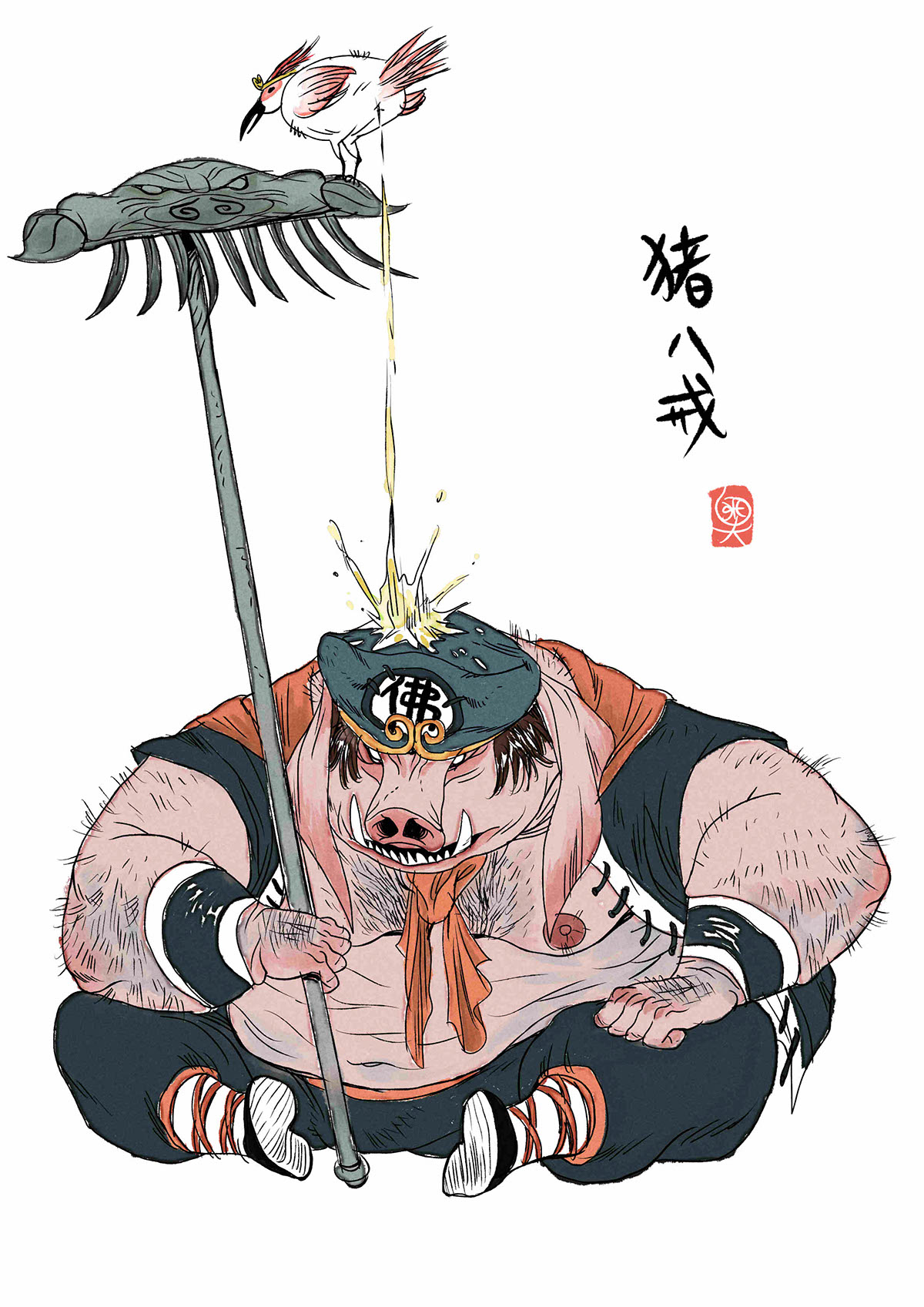
The pig orc is a hybrid, in more ways than one. As a beast-man of some variety, it is some sort of compromise between human and pig: perhaps in its origins some kind of literal hybrid, perhaps a convergent evolution of the boar towards bipedalism and talkativeness, perhaps a bioengineered warrior race, perhaps pigs which have reclaimed the bipedalism and chattyness that jealous men and their gods stole from them at the beginning of time. But in its conceptual use it is also a hybrid between the "orc" as we have received her from Tolkien, warcraft, warhammer, und so weter, and this pig-man. We are aware that the orc is Problematic (arguments to this effect will not be rehashed here; you either know and accept or know and reject them, but I'll be taking them for granted), and prompt reconsideration of paths not taken, such as the forays into the pig orc which our hobby once considered. By doing so we hope to rescue the patrimony of the orc - all the sustained half-lore and ideas that we've built up over the years, orc prayers and orc warfare and all the rest - from the vast condescension of a guilty conscience. Like a dying uncle who made a fortune from assorted bad deeds, or rapping slavers, we want to save the parts we've grown accustomed to and wash our hands of the rest: we want, as we have always wanted, to kill the orc and take her stuff. "Heritage, not hate!"

This is all just an uncharitable and spicy way of saying that the pig orc splits the difference in a productive way: all of the innocence of the cute furry animal races, all of the (salvageable) heritage of the word "orc." (In a vacuum, one could find anthropomorphic races a case of pseudospeciation with a long racist history, but in practice that's not how people read it - we associate talking upright animals with goofier and more forgivable vices - and since we're talking about symbols, how people take it is the truth of the matter.) Moreover, we get mileage out of it: centering "pig" within the name "orc" lets us reflavor and worldbuild our orcs in any number of ways, rethinking them in a new light. (Pigs like to sniff out truffles; what is the relationship between the pig-men and the mushroom-men?)

Moreover this is not just a one-time concept, but a repeatable move. Most obviously, you can consider the other Canonical Fantasy Races. What are the differences between elves that are plants (as in Glorantha), vs. cats, peafowl, jewelry, beta fish? Dwarves that are termites, bats, naked mole rats, mushrooms, automata, pitbulls? Halflings that are frogs, rabbits, potatoes? (And what is the difference between "cat elves" and "catfolk?" Surely that you're injecting some sort of Tolkienian melancholy into the concept of cats.) Ontologically "penguin lizardfolk" (or whatever) becomes possible just as soon as the concept of "lizardfolk" starts exceeding "lizard + folk," outgrows its old suspenders and can be draped in new clothes.

This can be extended further, of course. A farmer wizard breeds and cultivates spells, whereas a dentist wizard notices problems and fixes them painfully. A lion tamer cleric has a different relationship to the gods than a diplomat cleric or your usual fawning servant cleric. A starving artist fighter really cares about their technique in a different way.

How far can this be extended?

Maybe I have just gotten overexcited by the idea of analogies?


顽 形