This is a blatant ripoff of Max's (weird and) wonderful element generator and worlds with missing elements. But steal from one genius and you're a common thief, steal from a dozen and you're a scholar. So I've taken the liberty of stealing from/utterly misunderstanding the systems of all the great natural philosophers - Thales, Lucretius, Zou Yan, Menocchio, Decartes, Newton, Time Cube Guy.

religion in Tlön and Mlejnas
There are no big salvation religions on Tlön.[1] What there are are cults, understood in the nonderogatory sense; mythopoesis, which is sort of like worldbuilding; and rites, which are just traditional actions that are taken and don't require a lot of belief. Additionally, there is petitioning for hronir or dream-ghosts, which might be compared to prayer - you're asking for something - but is probably a lot closer to The Secret or the like - the mechanism is that the universe is responding to what you're consciously or unconsciously thinking about.[2] Finally, there are various altered states of consciousness, but just like American culture thinks of some of these under various banners (religion, recreation, increasingly mental health with stuff like light mindfulness) so does Tlön and Mlejnas.
[3] Yes, this does mean that people can know about religious and political doctrines from "our" world; no, this does not mean they take them any more seriously as plausible methods of worship or organization than we would most fictional works, even if they take the project as a serious religious and cultural one. Isekai dream ghosts from Earth sometimes do appear and try to proselytize these, but the fact that these usually end up in miserable failure only reinforces that they're ridiculous. Of course, maybe your character sees things differently.)
Mythopoesis and family cults
Mythopoesis involves describing and elaborating another world; the Anglo-American Cyclopaedia is merely the largest, most public, and most prestigious of these projects.[3] Almost every family in Mlejnas (other regions differ) has at least a cult of its ancestors and a mythopoetic tradition internal to itself; these are not to be shared with outsiders and, in fact, if you know enough about someone's family mythopoesis you can curse them. Married couples construct a private mythopoesis that is only shared with them and certain health specialists from magician lodges, which may diagnose problems with their children as stemming from mythopoetic errors - defects from inconsistencies, weaknesses from lack of elaboration, and of course curses from inappropriate sharing.
Each family also has a very large blanket representing every member as a section - newly expanded for children, cut off and the sewn into for husbands, and delicately cut off and used for garments in the Laughing House for the dead. (It is in fact individual disclosure from someone who is part of the family garment that allows mythopoetic curses; hearing it second-hand doesn't count. What's more, hearing it under duress doesn't count. However, even this kind of second-hand sharing is seen as highly socially inappropriate, very similar to how we would see the sharing of revenge porn.) Those who share family mythopoetry and expose the family to
curses are ritually expelled in highly emotional rituals - pelted with
dung, their section of the blanket cut off, never to be accepted in polite society again. (This may be how you became an adventurer.)
Magician lodges
Magician lodges are understood as a substitute family, and in fact when someone joins one, the lodge pays their family a dowry. Each magician lodge has its private mythopoesis, private rites, often has a private cult, and so on, which must not be shared with outsiders. (While sharing familiy mythopoetry results in shame and expulsion, revealing the secrets of a magician lodge typically results in being tortured to death and put on public display somewhere in the desert, your spirit warped into some kind of awful monster.) In Mlejnas, magicians are generally understood as so far outside the normal system of family life and reproduction that they are seen as being genderless regardless of anatomy, though many magician lodges have been implanted from elsewhere and have different ways of looking at this. (If you feel uncomfortable with your gender identity and/or role, you can probably find a magician lodge that more closely matches what you're looking for... but you can probably also get that through moving to the city of Mlej, where middle-aged people are mostly foreigners and have all kinds of conceptions. Joining a lodge means cutting all pre-existing ties, being subjected to far worse hazing than you're likely to get from your family for just about anything, and engaging in a variety of dangerous and dubious practices. Don't join unless you want spiritual limit experiences and/or power.)
Most magic-using classes are part of magician lodges, but not always - particularly skilled hronir-seekers may be diviners or illusionists, and disciplines like astrology, dowsing, and engineering are understood as difficult skills to master but ones that can be practiced by the general public. Mythopoetic curses can be practiced by anyone. There may also be weird stuff like the bacteria-drinkers.
"Civic" cults
The city of Mlej, like most major cities through Tlön, has a civic cult; these city cults are remarkably like sports fandoms in that (1) they have an anthropomorphic "mascot" figure at their center (2) they may be brought in to deal with athletic and other cultural events or contests (including lawsuits and diplomatic overtures) between other cities, as well as matters of formal civic events like the opening and closing of the senate, (3) they help organize the calendar, (4) they are the center of mass rallies and slogans at certain festivals.
The mascot of Mlej - who is also called Mlej - resembles an ichtyphallic, three-eyed cortical homunculus painted yellow and green, with long red and black hair that is woven into a bun in times of war and mourning and hangs loose otherwise. The Captain of the Senate (a position rotated between the matriarchs of the major families) marries him at the beginning of each year, and divorces him at the end at a humorous ceremony where each engage in staged bickering. (Prominent poets look with envy on the right to write these, which represents not only a display of wit but also one in which criticism of both the leadership of the city and city as a whole can be criticized - within, of course, certain limits.)
f.n.
[1] There is one arguable exception in the soteriological aspects of the the Sublime Philosophy. According to the Doctrine of Modal Realism, every possible world exists, according to the Doctrine of Counterfactuals of Freedom, transworld identity is established by being the sort of being who would act in such-and-such a way under such-and-such conditions. You will always be you and act in the way that you would, holding external conditions the same (after all, once we take away, that your internal character is all that's left.) Now, obviously, worlds full of good, kind, cooperative people are better places to be than ones full of inveterate jerks. But an inveterate jerk is likely to end up in a world only in proportion to how often inveterate jerks appear there. What this shakes out to is that there are an infinite variety of heavens and hells, of which Tlon (or Earth, and so on) is just one, and on average, the better version you are, the better the place you'll be reincarnated.
[2] You might ask if anyone has put these to an empirical test. Of course they have. While all acknowledge that the effects are probabilistic, researchers setting out to prove hronir have found it, while researchers subscribing to no-hronir Nine Coins Heresy have found evidence that this is all illusion. This itself is taken as excellent meta-evidence for the orthodox position, as is the difficulty of the later in accounting for printer glitches (see question 3), Earth isekai, and so on.
[3] Yes, this does mean that people can know about religious and political doctrines from "our" world; no, this does not mean they take them any more seriously as plausible methods of worship or organization than we would most fictional works, even if they take the project as a serious religious and cultural one. Isekai dream ghosts from Earth sometimes do appear and try to proselytize these, but the fact that these usually end up in miserable failure only reinforces that they're ridiculous. Of course, maybe your character sees things differently.)
Tlön, Week 2: surrounding area
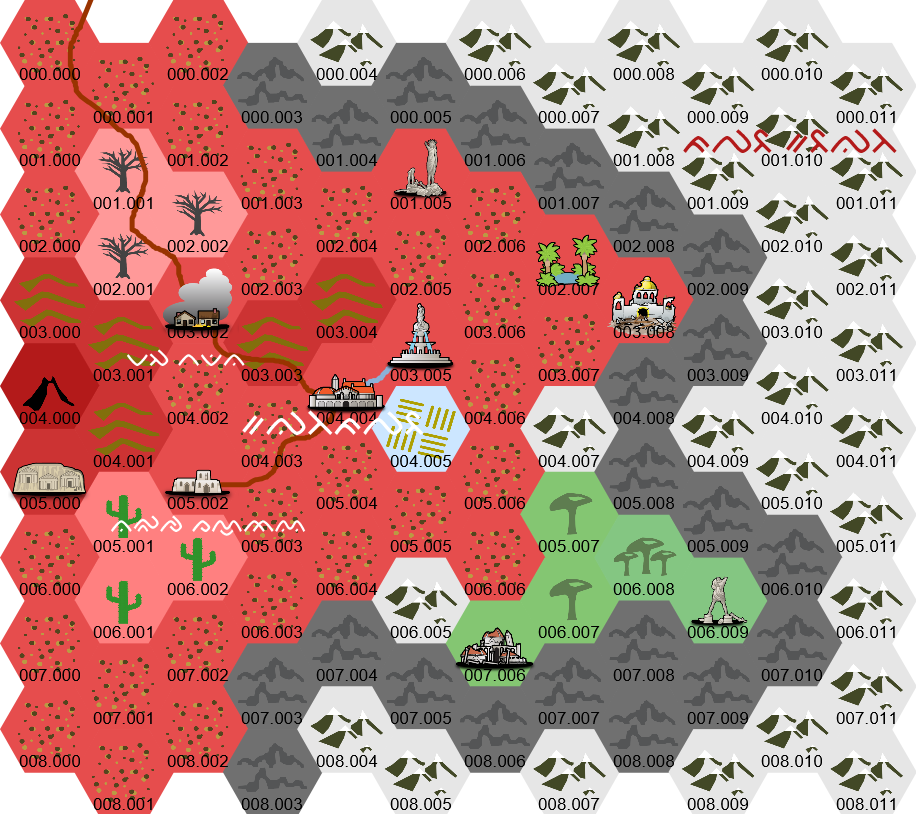
An experimental widget thing in lieu of a proper encounter table
I'm convinced the format of this thing has potential, but didn't have the time to really make it shine. In the future I can imagine myself making this the only way Tlön or some other setting is presented.
Settlements too small to picture on the map
Most people are free peasants, and live most of their lives in very small thorps and hamlets - generally just an extended family living in a cluster of households; there they grow maize, squash, and beans, with goats and ostriches to forage and hearth coyotes to guard them.

In the past, there was an elaborate system of canals that fed larger settlements across the region. These have fallen into disrepair - the newer and active settlements are based where dowsers can find a well, or where there's otherwise favorable geography (typically placing buildings on a mesa overlooking a basin where some water arrives.) The old ghost towns have been picked dry of any miracles or useful materials that are easy to grab, but some are still available. At the height of the empire automated home security systems were built into many upper-class houses; their residents are gone, but the solar paneling and genius loci of the houses remain. These ghost towns are also often frequently the site of healing temples, magician lodges, bandit hideouts - all in all, a compendia of things best forgotten.
Mlej, a major settlement
Mlej (4.4) is a large city which is no longer quite as large as it used to be - whole sections of the city are uninhabited, typically those regarded as inauspicious or ghost-haunted. (The most elaborate and ancient palaces are not home to the city's senatorial families but to even more elaborate versions of the home security systems that can be found in the ghost towns.) Nevertheless, Mjelnas has done well for itself. Thanks to the large water pump system at 3.5, it is able to support the heavy irrigation fields at 4.5 and, through this, a significant surplus population, part of which is used to finance and buy off settlements elsewhere, and part of which is used for the city's distractions and carnival culture.
Since a significant portion of the regional population lives in settlements too small to mark on the map - just a few households comprising an extended family; little thorps of a few households supported by squash, beans, and ocasional petty drills or subventions of water from the city proper - and marriage is exogamous, the desire for young folk to mingle and eventually marry is in large part satisfied by the central hub of Mlej. With a variety of cultural metaphors connecting the beginning and end of life to midnight, this period - generally from late teens to early twenties, somewhere between an Amish rumpsringa and an American adolescence - is generally known as the "morning" of life. Youth living out their morning in Mlej are expected to serve some years of service to the state - in the army, or engineering corps, or some other institution that serves the city and its ruling families. (Unlike the American college experience, there is little expectation that these young people will be learning skills that will be especially useful in their later lives, which they can after all learn better from their parents and aunts and uncles back on the farm, or high culture, which is a status marker of the senatorial families and their attendants. It is rather a corvee of able-bodied labor with a carnival atmosphere. The most important "educational" point, for all but a minority of them, is to be impressed by the wealth and generosity of the ruling elite.) The immediate effect of all of this is that Mlej is dispropotionately filled with people in the most violent, horny, inebriated, and uncertain stage of life, a fact that effects every aspect of its daily life. When the fun is over and adulthood begins, the couples typically go to the bride's village, which pays the groom's village for the loss of their son.
While the peasants working bean agriculture throughout the countryside are free, those working the paddy fields in the immediate shadow of Mlej are debt slaves. As elsewhere across the old empire of Tlon, Mlenjas has an Office of the Voice of Slaves, which protects their legal rights - that accurate ledgers are kept of their debts, that their days of service are rewarded according to a certain kept table, that families are not broken apart, that physical punishments are kept within certain limits, that they may participate in certain religious festivals and obligations, and so on. (Needless to say, the Office of the Voice of Slaves is effectively owned by the same families that own every other major institution in Mlej - including the slaves and the irrigation fields where they work.) Debt slavery is not formally hereditary, and there's enough influx and outflux of membership that it's not understood as a racialized institution, but multigenerational slavery is extremely common. The city is perfectly aware of its dependence on the institution, and schedules of fines and rates of interest are regularly adjusted to ensure that the population of debt slaves remains large enough to provide the rice that feeds it. Some heresiarchs suggest that the "morning of life" and its period of service could be extended to serve this function instead, but this is a minority opinion.
The Jangrs
North Jangr (3.2) and South Jangrs (5.2) were and are, respectively, subordinate towns of Mlej - proper towns, too; with many families and their own (but subordinate) governments. This was and is, respectively, possible because of the valleys of cactus which grow here, thick as jungles, based on their ability to grow deep into some unknown aquifer. This is also why North Jangr was done away with. The city-region of Oxlunas and its allied nomadic people, the stirrups-and-emu equipped Nlanx, put the whole northern region to torch and axe on the grounds that the unknown aquifer in question was their own.
From the perspective of imperial law, Oxlu's case is excellent. A legation of philosopher-engineers, dowsers, and poet-lawyers was sent to raise protest, seek recompensation, and propose a variety of neutral arbiters - only one of whom was the centuries-silent imperial carpet of Tlön; and most of which were respected oracles, such as the Reverse Tree of Hach and the Vampire Sages of Accursed Molshas. Mlej refused this arbitration out of hand, and so the Nlanx were dispatched to collect damages. The influx of refugees from North Jangr has led to a variety of responses - worries about how much food there may be to go around, outrage at those who refused to arbitrate like civilized imperial subjects, but most of all proto-nationalist jingoism directed at perfidious Oxlu and the barbaric Nlanx.
As for the still-standing cactus region near South Jangr, it is in principle a rationally planned plantation for the extraction of water and nutrients from sun above and sea below. In practice, the stuff isn't growing too slowly but too quickly, encouraging the growth of parasites on this project of rational economic exploitation - carnivorous caryophyllales and strangling vines; flocks of aggressive, eusocial hummingbirds; free communities of foragers who hide in the mazes of growth. The efforts of the state and other senatorial investment mechanisms to uproot these weeds, however, is on hold while the greater emergency of North Jangr takes precedence.
North Jangr (3.2) and South Jangrs (5.2) were and are, respectively, subordinate towns of Mlej - proper towns, too; with many families and their own (but subordinate) governments. This was and is, respectively, possible because of the valleys of cactus which grow here, thick as jungles, based on their ability to grow deep into some unknown aquifer. This is also why North Jangr was done away with. The city-region of Oxlunas and its allied nomadic people, the stirrups-and-emu equipped Nlanx, put the whole northern region to torch and axe on the grounds that the unknown aquifer in question was their own.
From the perspective of imperial law, Oxlu's case is excellent. A legation of philosopher-engineers, dowsers, and poet-lawyers was sent to raise protest, seek recompensation, and propose a variety of neutral arbiters - only one of whom was the centuries-silent imperial carpet of Tlön; and most of which were respected oracles, such as the Reverse Tree of Hach and the Vampire Sages of Accursed Molshas. Mlej refused this arbitration out of hand, and so the Nlanx were dispatched to collect damages. The influx of refugees from North Jangr has led to a variety of responses - worries about how much food there may be to go around, outrage at those who refused to arbitrate like civilized imperial subjects, but most of all proto-nationalist jingoism directed at perfidious Oxlu and the barbaric Nlanx.
As for the still-standing cactus region near South Jangr, it is in principle a rationally planned plantation for the extraction of water and nutrients from sun above and sea below. In practice, the stuff isn't growing too slowly but too quickly, encouraging the growth of parasites on this project of rational economic exploitation - carnivorous caryophyllales and strangling vines; flocks of aggressive, eusocial hummingbirds; free communities of foragers who hide in the mazes of growth. The efforts of the state and other senatorial investment mechanisms to uproot these weeds, however, is on hold while the greater emergency of North Jangr takes precedence.
The Continental Chasm
The continental chasm consists of a deep ravine stretching down miles, and then eventually rising up again. The fantastical speculations of the Old Empire's mythopoetry variously imagined solutions to this geographical mystery - that it represented the journey of the soul striving towards a happier state (a terrible gulf separating us from higher ground, into which one must first descend;) that it instead represented the minimization of contact that must be made between nobles and commoners or otherwise ritually clean and unclean; or even that it was the result of two vast landmasses smashing into each other, one of which was being sucked into the other (this itself being an elaborate metaphor.) Less philosophical minds instead gather that it is just the largest sort of ravine, formed by ice runoff from the uplands.
The continental chasm consists of a deep ravine stretching down miles, and then eventually rising up again. The fantastical speculations of the Old Empire's mythopoetry variously imagined solutions to this geographical mystery - that it represented the journey of the soul striving towards a happier state (a terrible gulf separating us from higher ground, into which one must first descend;) that it instead represented the minimization of contact that must be made between nobles and commoners or otherwise ritually clean and unclean; or even that it was the result of two vast landmasses smashing into each other, one of which was being sucked into the other (this itself being an elaborate metaphor.) Less philosophical minds instead gather that it is just the largest sort of ravine, formed by ice runoff from the uplands.
Along the face of the chasm, cliff-dwellers carve out little villages. These are both temporary and longer-term affairs - longer-term because what is carved will be in principle useable for centuries or millennia, temporary because any given use of it depends on which qanats can be found flowing at any given time.

Mlej regards the cliff communities as thieves thrice over - first, because it is charged that they are the hideouts of bandits, second, because their use of the qanat system constitutes a theft from the aquifers of Mlejnas, and third, because their numbers are perpetually nourished by the influx of escaped debt slaves. The first is true often enough, the second plausible (ignoring the systems on the far cliff of the chasm), the third indubitable.
The True Land
In the dark southeastern penninsula, there is almost no sunlight, flanked as it is by upland, but (it is suspected) abundant water, due to its abundant fungal growth. This place has been called the True Land, because as the Sublime Philosophy of old Tlön held that only perception is real and mind makes the world, it truer here than elsewhere; physicians speculate that the abundance of spores in the air clear out men's perceptual faculties. Still, it is said that too much freedom and/or reality is bad for men, and that regular contact with illusions such as non-poisonous food, potable water, and a sense of absolute direction are necessary for their continued existence in their present mortal forms. The True Land can be taken as evidence of this just as much as it is evidence for the Sublime Philosophy, if the latter had ever needed anything as profane as evidence for its splendor.
the Anglo-American Archives
The Anglo-American Archives (3.8) represents in principle the site of continuation of the greatest scholarly project of the Old Empire, the Anglo-American Cyclopaedia, an elaborate dictionary of a fantasy world ("Earth") written in a fantastically inventive conlang ("Anglo-American," or, in its own tongue, "Español") that prioritizes nouns over verbs or adjectives. The Cyclopaedia represented many things to the Old Empire - a grand project of public mythopoesis (in contrast or complement to the family mythopoetry lineages that are still practiced over Tlön,) a means of criticizing authorities in disguise (a practice which, rather than being a thorn in the side of the censors, was largely approved by them, and who regarded any criticism to subtle to evade their own literary analysis as too subtle to have any effect outside of the fantastical world of Earth), and as a religious application of the Sublime Philosophy itself.
Today, however, the Archives and Cyclopaedia are in like confusion. New work on the project has all but halted as librarians try to save what information can be saved and to collate what information can be collated. Moreover, dream-ghosts (hronir) of Anglo-America and other fanciful Earth regions appear in the hardly-accessible upper and lower levels of the Archive, and some of these are actively dangerous. Occasionally not just dangerous beasts and terrible artifacts but living, speaking women and men appear, claiming to be from Earth and sometimes being welcomed as heroes to save Mlejnas or other regions of Tlön. The this-worldly efforts of these messiahs to help out, however, ends as often in tragedy as not (some of them, no doubt, are deliberate frauds) and if anything their import to scholars is more disappointing than anything - the information they report of Earth is if anything even more contradictory than the written materials.
In the dark southeastern penninsula, there is almost no sunlight, flanked as it is by upland, but (it is suspected) abundant water, due to its abundant fungal growth. This place has been called the True Land, because as the Sublime Philosophy of old Tlön held that only perception is real and mind makes the world, it truer here than elsewhere; physicians speculate that the abundance of spores in the air clear out men's perceptual faculties. Still, it is said that too much freedom and/or reality is bad for men, and that regular contact with illusions such as non-poisonous food, potable water, and a sense of absolute direction are necessary for their continued existence in their present mortal forms. The True Land can be taken as evidence of this just as much as it is evidence for the Sublime Philosophy, if the latter had ever needed anything as profane as evidence for its splendor.
the Anglo-American Archives
The Anglo-American Archives (3.8) represents in principle the site of continuation of the greatest scholarly project of the Old Empire, the Anglo-American Cyclopaedia, an elaborate dictionary of a fantasy world ("Earth") written in a fantastically inventive conlang ("Anglo-American," or, in its own tongue, "Español") that prioritizes nouns over verbs or adjectives. The Cyclopaedia represented many things to the Old Empire - a grand project of public mythopoesis (in contrast or complement to the family mythopoetry lineages that are still practiced over Tlön,) a means of criticizing authorities in disguise (a practice which, rather than being a thorn in the side of the censors, was largely approved by them, and who regarded any criticism to subtle to evade their own literary analysis as too subtle to have any effect outside of the fantastical world of Earth), and as a religious application of the Sublime Philosophy itself.
Today, however, the Archives and Cyclopaedia are in like confusion. New work on the project has all but halted as librarians try to save what information can be saved and to collate what information can be collated. Moreover, dream-ghosts (hronir) of Anglo-America and other fanciful Earth regions appear in the hardly-accessible upper and lower levels of the Archive, and some of these are actively dangerous. Occasionally not just dangerous beasts and terrible artifacts but living, speaking women and men appear, claiming to be from Earth and sometimes being welcomed as heroes to save Mlejnas or other regions of Tlön. The this-worldly efforts of these messiahs to help out, however, ends as often in tragedy as not (some of them, no doubt, are deliberate frauds) and if anything their import to scholars is more disappointing than anything - the information they report of Earth is if anything even more contradictory than the written materials.
The Laughing World
The necropolis build into the face of the volcano slopes of 5.0 - also represents a work of public mythopoesis, albeit one that is much more modest in its scope. Here, the respected dead are brought here to be interned, and on certain other festivals people come to help ensure their continued merriment - plying them with songs and alcohol, sequestering them to private rooms for liasons with each other, or moving them between various libraries and dance-halls for their continued amusement. Often when people return at the next festival, their ancestors have moved - sometimes very rarely leading to their expulsion from the community (such as when two mummies are found in bed together such that their combination would be incestuous, or when one is wearing some jewelry that the other mummy would not have willingly parted with.) Despite these independent movements, however, all agree that the dead appreciate the re-arrangements and the food and alcohol their descendants bring them, and in exchange the dead are consulted about matters of law and prophecy through trusted interpreters.
The living are not allowed past the first level of the Laughing World. These lower levels are reserved for the "dead of the dead" - once a mummy no longer has living descendants who remember her, her compatriots take her down to the next level in a second burial, and these are cared for by the dead of the first level in the same way that the living care for them. This process continues recursively for, it can only be assumed, forever.
The living are not allowed past the first level of the Laughing World. These lower levels are reserved for the "dead of the dead" - once a mummy no longer has living descendants who remember her, her compatriots take her down to the next level in a second burial, and these are cared for by the dead of the first level in the same way that the living care for them. This process continues recursively for, it can only be assumed, forever.
“Fair" ability score generators for 3d6-in-order and 4d6-drop-lowest
My least favorite method of rolling ability scores has always been “roll for stats, then assign" - it combines the unfairness of rolling with the lack of surprise from point buy. This method reverses that. Ability scores always add up to 63, but taken individually each has the same distribution as a regular 3d6 roll, and which abilities are best and worst are, of course, random.
If you're playing a later edition of D&D/decendants thereof where 4d6-drop-lowest is more normative, the following isn't as fair, but still gets at the spirit of the thing.
In addition to clicking once and "rolling" (so to speak) with it, you may wish to click as many times as you like until you get the stats you really want (Con of 10+ and Int of 14+ for a wizard, say) and letting all the rest inspire how you flesh out the rest of this character. Or whatever!
d666 reaction rolls
Here’s a quick thought that would be easy to expand on - make it a d888 or whatever if you’re more creative or just less puerile than I. Make each die a different color, though; you want to keep track of which is which. The first roll is the one you know:
- Friendly
- Neutral
- Neutral
- Wary
- Wary
- Hostile
Adjust to your favorite scaling as desired, but also ask: why are they so? If you already have a satisfactory answer, go with that. If not, it’s some kind of attitude towards someone. Fill up the second with something like:
- Admiration/hatred for...
- Fear/contempt (or pity/fear, whichever makes more sense) for...
- Familiarity with/alienation from...
- Opportunities to gain by being nice/mean to...
- Attraction to/revulsion for...
- Curiosity about...
And the third with something like:
- ...PC Alice
- ...PC Bob
- ...PC Carl
- ...PC Danielle
- PCs as a group
- themself
So 664 wants to test Danielle’s mettle. 152 wants to get in Bob’s pants (or be his friend, or substitute father figure, or whatever.) 345 is approaching the situation strategically. 516 is in a foul mood spurned on by self-hatred but might be cheered up.
delightful demons and angels of awful purpose
Outsiders in D&D are connected to alignment system, but the alignment system has always been ambiguous about whether it refers to psychology or behavior. This opens the room for outsiders whose psychology conforms to the core concept, but with behavior that isn't necessarily expected.
Evil angels are the easiest one, because you've seen them all before. Angels do whatever God asks of them, because God is good. God is indeed the fullness of being, and most of reality is contained within the godhead; all creatures are just a sort of ephemeral leftover. But it must be emphasized that even the angel who commits terrible atrocities, pouring out their philters of doom over Sodom or Jericho, weeps genuinely as they do so. How tragic, that the greatest good should require such! Like an abusive parent, they say "this hurts me more than you," and they are right. They are genuinely eager to avoid as much wrong as can be managed, and will be thankful to anyone who can point out creative solutions to the dilemmas ahead of them.
1d4 Angels of Awful Purpose
- He announces himself to prophets, holy men, and other worthies, and reveals the Divine Plan; these plans are lies, the prophecies false, that the face of the God might remain hidden, and faith remain faith. He smuggles in worthy moral teachings and the like when possible.
- She is tasked with ending intelligent life on this plane and has been spending the last few centuries disseminating information on birth control, celibacy, and the like. Her archangelic superior is coming, bearing a heavy heart and the news that the timetable must be moved forward.
- They tempt men and women with lust, money, and power, that their souls might be tempered, and that the halls of heaven may remain unpolluted. They may every attempt possible to choose those who will be tempted enough for it to be a difficult decision that forces them to bend, but not be broken. But sometimes they miscallibrate.
- It seethes with hatred for all life, for all justice, and for all goodness. It does this because there is another angel - its dear friend, in fact - who has been assigned the awful task of torturing the most wicked soul available, and it therefore needs a way to be wicked (and thus spare others) without hurting anyone. It plays a dangerous game of doublethink, for its wicked thoughts must be intense without being genuine enough to inspire it to truly act on them. Looking at the increasing evil of men, it binds itself in chains that it might go deeper into depravity and yet not become harmful, but no chain lasts as long as intended.
Chaotic devils have recognized the antagonistic rather than cooperative nature of reality, and that mixed and random strategies are often the right way to deal with an opponent, especially the omnipresent opponent of "everyone who isn't me." "Chaotic" devils employ these mixed strategies every bit as methodically as any other kind of devil; they forgo pleasurable opportunities, think about the long term, keep records of their behavior to spot and correct the existence of observable patterns.
1d4 disconcerting devils
- He is the Prince of Darkness, the classical Satan. When he first came into being he resolved he would cooperate with God if God cooperated with him, and (to maximize the chance of being cooperated with) to retaliate at any cost to himself if God did not cooperate. God then commanded him to do something other than what he really wanted, so he's at war with an omnipotent being. God works in mysterious ways, doesn't he? Anything you do can and will be turned against you. He tries to sow as much chaos as possible to interfere with the divine's plans; currently, he considers that doing good (or what would immediately seem to a mortal like good) mostly results in this moreso than evil.
- She rides with an order of paladins, righting wrongs and working justice. To let off steam she tortures animals and defiles corpses, since animals and corpses can't rationally commit to any decision theory so you don't need to include them in your Kantian calculations.
- It had a great gig torturing sinners in the depths below - eternal torture of sinners is good altruistic game theory after all, it's committment to a tit-for-tat equilibrium of the grim trigger type. And its fun! Now it's on earth for some reason and doing the rational thing isn't fun anymore. It can deal with this but doesn't like it.
- They cut a deal with a good god, and a deal's a deal.
Demons always do whatever they feel like, without any regard for their own or anyone else's interests. "Good" demons feel like helping people, and "lawful" ones feel like obeying particular rules or particular persons, but these are fundamentally whimsies and compulsions, not values or commitments. Some people believe that faeries are actually misclassified demons.
1d4 delightful demons
- He is a kindly doctor who follows the army, healing all regardless of who they fought for. He loves healing and, if he were ever placed in a long-term situation in which there were no wounded or dying around, he would make some for himself. However, under current conditions, he doesn't need to waste time on that - there are already plenty! If the war ends he might start following another band of violent miscreants, like the PCs.
- She sings at the local tavern for free. She's not especially talented on a technical level, but she enjoys it so much, it's infectious. Every so often she sings something truly beautiful, and when this happens, halfway around the world an innocent drops dead of a heart attack. She is not aware of this, and if made aware of it would not find it interesting.
- It loves to see children laugh and play! It is kidnapping them to its personal Hell where it stuffs them with candy, never have the iPad taken away, and never grow old!
- They whip themselves in the street: "repent! repent!" Everyone snickers that they don't really care about any of that religious stuff and just get off on the whole bit, and everyone is right.
1d4 other oddities
- Being of axiomatic law and logic that just discovered a flaw in the nature of logic itself, and feels obliged to eliminate it as it sought to eliminate other irregularities.
- Being of pure balance, gone excessively meta.
- Negative energy elemental who just found out that life furthers entropy.
- Positive energy elemental who just found out that life furthers entropy.
“10 monster setting" generator
Lots of people seem to like this, so why not join them? After all, this button automates all the work!
Tlön (late antique science-fantasy Mars), Week 1 (in which I hop onboard the Gygax 75 challenge train)

Pitch Points
- The Empire is dead, but no one is quite willing to admit it. The imperial carpet of Tlön conquered the known world and administered a cosmopolitan empire with surprising efficiency, co-opting local elites when possible and operating with speedy and frank brutality when not... until it didn't; everyone recognizes it, no one's willing to admit it. It's said that Lenin didn't seize power so much as find it lying on the ground. Alternately desperate and bold magician lodges, religious or national movements, and powerful families are picking up power for themselves, but everyone is desperately cooperating with the fiction that all these moves are in accordance with imperial norms and law. It won't last.
- The world is old, practically collapsing under its own weight. Fossil remains suggest that men live on what once was a sea bed. The remnants of ancient engineering (mechanical and biological) are everywhere; most magic is somehow connected with this. The wicked and wise First Folk, mighty sorcerers all, are still around; they're just reclusive and primarily interested in their own projects.
- Water is scarce, and growing scarcer. The world is a Martian landscape of red rock, annular lakes, continental uplands. Gardens and fountains - and lots of water-bought retainers and servants - are the best way to display your wealth. Air is thin and chill. Tidal stresses and a deep cave network extending into the cold, crimson earth mean that any given catchment area may find itself in short supply. Finding new aquifers or repairing old engineering constitute the main reasons to go dungeon-diving.
- A kitchen sink science-fantasy setting within the limits of the above - almost any kind of wizard fits in, as does almost any culture you make up. Science, magic, religion, philosophy are varied - what with all the deep history and cosmopolitan exchange, you can justify the inclusion of almost anything - but should never fit neatly into one of those four categories and not another; the division between them is a modern conceit.

- The obvious, but really mostly because the name "Tlön" itself is super compelling for me. Various fantasy Marses, Borroughs and Robinson and so on, are obviously in here as well.
- The landscape of the American southwest, especially in the Utah-New Mexico parts where lush green pine stands against ancient red rock, and the air is thin and dry. Ever since living in New Mexico I've found this an especially compelling visual environs.
- Chris Wayan's Planetocopia, especially Tharn but also Mars Reborn, Serrana, and others.
- The art of Moebius, which I'm not original in loving as a canonical touchstone of weird science-fantasy.
- Patrick Wyman's Fall of Rome podcast but also Peter Adamson's History of Philosophy Without Any Gaps and Earl Fontanelle's SHWEP.
- Literature on imperialism in general, but especially those that emphasize how it's a robbery racket but also a robbery racket that co-opts local elites, promotes cultural exchange, and creates ideological structures that can outlast the actual functioning of the racket itself. (Chris Wickham, for instance, frames the early middle ages as a sort of late late antiquity where imperial structures were dead and gone, but imperial notions of legitimacy were still the gold standard.)
- Visual culture from around the world, befitting the setting's cosmopolitanism, but especially architecture from Southeast Asia and the native American Southwest, and clothing from Central Asia and the Andes. (People are a lot more heavily clothed here than on Barsoom!)

“What food the stars eat, if they are animals:" 1d58 worldbuilding prompts from Adelard of Bath
Adelard of Bath lived in the twelfth century, studied Arabic science, and wrote down what he considered to be prize-winning scientific questions and his own best stab at them. These also make, incidentally, great worldbuilding prompts - they are, after all, something an intelligent person in a medieval milieu could look at and imagine different answers to, hence something where the completely bonkers metaphysics you just made up might produce something very similar to the taverns-and-sword-fights social reality that we all know and love to pretend at. Some of these are just fucking great ("what food the stars eat, if they are animals") some are most interesting for their look at how assumptions differ ("why women, if they are more frigid than men, are more wanton in desire") and some are rather small fry ("why those [animals] which ruminate lie down first on their hind legs and last on their forelegs.") Regardless, lest I impose my own assumptions about what is interesting too much, here is the full list, or at least the fullest version I could find:
- Why plants are produced without the sowing of seed.
- How some plants are called hot, since all are more of the earth than of fire.
- How different plants grow in the same region.
- Why they are not produced from water, air, or even from fire, as they are from the earth.
- Why, when a plant is grafted, the fruit is that of the grafted part, not the trunk.
- Why certain beasts chew the cud, and certain others not at all.
- Why those which ruminate lie down first on their hind legs and last on their forelegs.
- Why all animals which drink do not make water.
- Why certain animals have a stomach, and others do not.
- Why certain of them see more sharply by night than by day.
- Whether beasts have souls.
- Why men are not born with horns or other weapons.
- Why those who have good intelligence are lacking in memory or vice versa.
- Why the seats of imagination, reason, and memory are found in the brain.
- Why the nose is located above the mouth.
- Why men get bald in front.
- Why we hear echoes.
- How, as the voice comes to the ear, it may penetrate any obstacle.
- What opinions should be held concerning vision.
- Whether the visible spirit is substance or accident.
- Why, as one can see from the darkness into the light, one cannot similarly see from the light into darkness.
- Why we smell, taste, and touch.
- Why joy is the cause of weeping.
- Why we breathe out of the same mouth now hot and now cold air.
- Why the motion of fanning produces heat.
- Why the fingers were made unequal.
- Why the palm is concave.
- Why men cannot walk when they are born, as animals do.
- Why men are nourished more by milk.
- Why women, if they are more frigid than men, are more wanton in desire.
- Why men universally die.
- Why the living are afraid of dead bodies.
- How or why the globe of the earth is held up in the middle of the air.
- If the sphere of the earth were to be perforated, where a stone thrown into it would fall.
- How the earth moves.
- Why the waters of the sea are salty.
- Whence the ebb and flow of the tides come.
- How the ocean does not increase from the the influx of rivers.
- Why certain rivers are not salty.
- How the course of rivers can be perpetual.
- How sprints burst forth on a mountain top.
- Whether there may be other true springs.
- Why water does not go out of a full vessel open in the lower part, unless an opening is made above.
- Whence the winds arise.
- Whence the first movement of air proceeds.
- Whether, if one atom is set in motion, all are set in motion, since whatever is moved moves something.
- Why the wind does not move around the earth to the upper regions.
- Where or whence such great impetus comes to it.
- Where thunder comes from.
- Where lighting comes from.
- Why lightning does not come forth from all thunder.
- By what power lightning penetrates stones and masses of metal.
- Why, when we see the fire, we do not hear the crash, either at once or forever.
- Why the planets and especially the sun do not keep their courses through the middle of the aplanon [outermost and immovable sphere of heaven] without revolution.
- Whether the stars fall, as they seem to fall.
- Whether the stars are animated.
- What food the stars eat, if they are animals.
- Whether the aplanon should be called an animate body or God.
Quick Combat: a preliminary stab (har har) at a system
(In the course of finding her injury system to link to, I find that Emmy Allen did this exact thing, but without the weird morale bidding mechanic. Go with your preferred version or mix your own, but if you do mix your own, let me know!)
This is a (proto-?) system for those who like "combat" in the sense of a constant possibility of mortal danger that haunts exploration or social scenes, but not "combat" in the sense of taking a long break from exploration/social scenes to play a tactical minigame. This more or less entirely removes "combat as sport" in favor of "combat as war."
0) This system is to represent combat situations that are plausibly in
doubt. If five children ambush four dragons, the dragons still win even
though the children have numbers and surprise on their side.
1) When combat begins, everybody chooses Morale - a number from 1-12 - secretly passing them to the GM if desired.
2) Roll 1d6. This represents the decisive factor in battle.
3) Each combatant on the losing side rolls 2d6. If they roll over their Morale, they ran away (or are captured if escape is impossible and the enemy takes prisoners - or they successfully played dead, or whatever). If they roll under or equal to their Morale, they're dead (or also possibly captured, &c, depending on the circumstances).
(Note that losing combat is a mechanical condition while winning is not. You "win" if making your opponent lose accomplishes whatever extra-combat goal you happened to have.)
4) Regardless of whether your side won or lost, if you didn't die, roll 2d6 (one red die, one blue) and compare it to Morale again, or Morale + 3 if you lost. If it's under (not equal) to your Morale, you sustain injuries. Different opponents may have different charts to determine how they wounded you, but by default consult the red die rolled and the following chart:
1) When combat begins, everybody chooses Morale - a number from 1-12 - secretly passing them to the GM if desired.
2) Roll 1d6. This represents the decisive factor in battle.
- Numbers: whichever side has fewer combatants loses.
- Might: whiever side has lower average HD loses.
- Cohesion: whichever side has lower average higher morale loses.
- Leadership: whichever side has the best single combatant - as defined by Morale + HD - does not lose, but rather the other side loses.
- Positioning: whichever side has worse circumstantial advantage wins. If in doubt, the defender loses, unless they are defending a fortified position, in which case attacker loses.
- Mutual Ruin: both sides lose.
3) Each combatant on the losing side rolls 2d6. If they roll over their Morale, they ran away (or are captured if escape is impossible and the enemy takes prisoners - or they successfully played dead, or whatever). If they roll under or equal to their Morale, they're dead (or also possibly captured, &c, depending on the circumstances).
(Note that losing combat is a mechanical condition while winning is not. You "win" if making your opponent lose accomplishes whatever extra-combat goal you happened to have.)
4) Regardless of whether your side won or lost, if you didn't die, roll 2d6 (one red die, one blue) and compare it to Morale again, or Morale + 3 if you lost. If it's under (not equal) to your Morale, you sustain injuries. Different opponents may have different charts to determine how they wounded you, but by default consult the red die rolled and the following chart:
- Just a scratch.
- If you had a shield, light armor, or heavy armor, you're fine. If not, roll 1d6 again.
- If you had heavy armor or a shield, it's shattered. If not, roll 1d6 again.
- You lost a hand, an eye, or something else useful.
- You have a deep wound and are greviously injured. You cannot exert yourself for the next day and will need to be under care.
- You are mortally wounded, and though you can move around, you will need to seek treatment in a center of civilization within 1d12 days (referee rolls secretly) or you will die.
Alternatively, steal from Cave Girl's injury system in some way.
of Phantoms; or, what it's like to seem to be
An illusionist who meets their third and final Doom becomes an illusion permanently. Such sad sights - and sights they are - are but one origin of a class of creature called phantoms, variously employed and studied by illusionists the worlds over, and seen and heard by people of all sorts. The lay consensus is that such creatures are not "real," but this is exactly the kind of stray comment that will catch you in the pedantic crosshairs of a stray philosopher or other master of illusion.
The practicing illusionist - or adventurer who has struggled with phantoms - is wont to sneer in response that naturally these creatures are real, insofar as their effects are real. (This is the famed Tomiss Theorem, of the academician-elector Shofas Tomiss' essential Propaedeutics of Sorcerie.) But furtherly philosophical illusionists are likely to respond that this, in turn, lacks ontological nuance as to the precise status of phantoms and other illusions. An illusion must not be regarded as something unreal in the sense that (say) a computer or good demon must be regarded as something unreal (something outside of the world, not existing in the sense of not interacting with all of its other parts) but at the same time it is not like (say) a stone or a unicorn, one ordinary object enjoying the full franchise of existence alongside all the others. Illusions are that which, if they were to cease being observed, go away. These are perfectly efficacious and "real" as far as it goes, like laws and money, but like laws and money, a phantom needs real social supports to keep going, and illusionists approaching their Doom often make arrangements for the same.
This answers the question every novice apprentice has - or every wicked apprentice assumes - about phantoms, that being whether they have an internal life. A phantom has "real" experiences if those experiences are observed. The more astute of the apprentices reply: "but wait, aren't our own conscious experiences the same way? Don't we have 'an inner life' only by virtue of observing our own experiences, self-reflectively?" Exactly so. And the scholarly consensus of illusionists is that illusions properly "feel" pain, heartbreak, hopes, and (above all) dreams - but that they need to be observed doing so in order to, just like anything else. (The bright and terrible angels, who in their calculations disregard the good and bad accrued to phantoms, err here; but that is because they see through all lies, which is why they care not for aforesaid laws or money either.) Specifically, they must in practice be observed by others. In principle, infinite levels of self-reflective awareness - I observe that I observe that I observe that I... - would suffice, but who can manage that?
(It also follows from this that phantoms have, in most cases, no subconscious. Most of us have pains, hopes, and dreams that we are not aware of, but phantoms who wish to retain a subconscious must arrange to be under the continuous observation of a psychotherapist.)
An illusionist that manages to stably maintain their continuity of consciousness (much less subconsciousness) after becoming a phantom may be regarded as the rough equivalent of the necromancer that continues on as a liche. Any competent illusionist by definition can arrange to summon illusions to observe her, but these also require their own observers. Demons can also be summoned by allied or indebted spellcasters, but these wretched creatures cannot see goodness, and the phantoliche existing only in the eye of these beholders is wont to be swift corrupted. Angels see goodness and badness both, and with what awful intensity! - but not, as noted, illusions.
The practicing illusionist - or adventurer who has struggled with phantoms - is wont to sneer in response that naturally these creatures are real, insofar as their effects are real. (This is the famed Tomiss Theorem, of the academician-elector Shofas Tomiss' essential Propaedeutics of Sorcerie.) But furtherly philosophical illusionists are likely to respond that this, in turn, lacks ontological nuance as to the precise status of phantoms and other illusions. An illusion must not be regarded as something unreal in the sense that (say) a computer or good demon must be regarded as something unreal (something outside of the world, not existing in the sense of not interacting with all of its other parts) but at the same time it is not like (say) a stone or a unicorn, one ordinary object enjoying the full franchise of existence alongside all the others. Illusions are that which, if they were to cease being observed, go away. These are perfectly efficacious and "real" as far as it goes, like laws and money, but like laws and money, a phantom needs real social supports to keep going, and illusionists approaching their Doom often make arrangements for the same.
This answers the question every novice apprentice has - or every wicked apprentice assumes - about phantoms, that being whether they have an internal life. A phantom has "real" experiences if those experiences are observed. The more astute of the apprentices reply: "but wait, aren't our own conscious experiences the same way? Don't we have 'an inner life' only by virtue of observing our own experiences, self-reflectively?" Exactly so. And the scholarly consensus of illusionists is that illusions properly "feel" pain, heartbreak, hopes, and (above all) dreams - but that they need to be observed doing so in order to, just like anything else. (The bright and terrible angels, who in their calculations disregard the good and bad accrued to phantoms, err here; but that is because they see through all lies, which is why they care not for aforesaid laws or money either.) Specifically, they must in practice be observed by others. In principle, infinite levels of self-reflective awareness - I observe that I observe that I observe that I... - would suffice, but who can manage that?
(It also follows from this that phantoms have, in most cases, no subconscious. Most of us have pains, hopes, and dreams that we are not aware of, but phantoms who wish to retain a subconscious must arrange to be under the continuous observation of a psychotherapist.)
An illusionist that manages to stably maintain their continuity of consciousness (much less subconsciousness) after becoming a phantom may be regarded as the rough equivalent of the necromancer that continues on as a liche. Any competent illusionist by definition can arrange to summon illusions to observe her, but these also require their own observers. Demons can also be summoned by allied or indebted spellcasters, but these wretched creatures cannot see goodness, and the phantoliche existing only in the eye of these beholders is wont to be swift corrupted. Angels see goodness and badness both, and with what awful intensity! - but not, as noted, illusions.
The preferred set of arrangements for an illusionist expecting to meet his Doom consists of some kind of entailed land or other passive income - bonds, interest collecting in the bank, and other purely financial instruments are often preferred for aesthetic reasons - supporting fawning servants interacting with (and, above all, observing) a network of illlusionists. Often a charitable foundation for the education of bards is involved; these bards act as the literary critics, psychotherapists, dramaturges, and publicists required to ensure that, however indirectly, the phantoliche exists under continuous observation. Another popular option (with similar aesthetic appeal for the profession) is the religious foundation, with the phantoliche presented as a kind of god. Both may hire adventurers, of course, being limited in mobility.
Atheists derive at least two sources of delight from the phantom. The first is that the limited endurance of phantoms disproves any omniscient being, the second is that if minor cults may have sprung around phantoliches, major ones may have as well. What else could explain the desire of the gods for worshipers, or the popular superstition that if they were to cease to be believed in, the gods would fade? That they are acknowledged by angels is a stumbling block to this theory, but perhaps this is an advanced trick - or perhaps the angels, as poppets of these mighty wizards, refuse to acknowledge other illusions for fear of their power being usurped. Many a mystery cult based around evading the tricks of the Grand Illusionists Who Rule the World forms in the undergrad dorms of the illusionists college, before most illusionists become distracted by the ease of worldly achievements - another trap of the these demiurges, say the cults.
Although becoming a phantoliche requires a lot of work, this is ultimately not why most illusionists disdain to do so. To be continuously observed by others even in one's inner life is unbearable to most humans and like mortal folk; for illusionists, who typically entered the profession that others might perceive them as they might prefer, it is an especially horrid fate. The phantoliche is, almost by definition, a primadonna, and probably had a need to be seen even before their proper Doom.
d20x4 prophecies
Velexiraptor's prompt generator gave me "prophecies, NPCs, and d20 tables." That sounds doable.
Subscribe to:
Posts (Atom)