feudal crisis generator


Last post I employed the weapon of criticism-self-criticism to note that "reified ethnic groups and Great Men" did not perhaps represent an accurate social ontology. In the comments to another, I admitted to using the sub-phreno-astrological domain of personality psychology for a character generator backend. And for this tendentious opening, a Joesky tax is owed. Thus, I drop all namby-pampy magic elves heroes nonsense to present reality as it really is: an unending series of ecological crises, pointless wars, and unwinnable class struggle.

folks & factions

This gives an interconnected bunch of ethnic and political groups. In reifying the former and focusing the latter on leading individual actors it may not embed the same social ontology as something that reflected more Effort, but, well, that's the interpollating power of ideology for you. Be that as it may, reload as many times as are necessary to be both coherent and interesting.

ability scores describerizer

Input ability scores manually or via your rolling method of choice; get a character description. Functions most naturally for first-level PC types in Generic Fantasyland, but can function for other purposes as needed. May get less repetitive as I fill it with more Content.


NITЯRONIKΛ: Creating a setting using all of my awful generators together

Well, a lot of them, anyway. I initially reserved the right to throw out results, but my first on every table was so generous that I will instead only reserve the right to generate them with latitude. So starting with the Ionian Ontology generator for our basic cosmology and physics, we get: 

This world is an expanse, mostly void, with 3 dimensions extending out infinitely with a single point which is the "center" or "bottom" of the universe. There are three elements: concrete, liquid nitrogen, and propane, which settle in concentric shells around the center in that order. All matter has a baseline level of awareness and will - for instance, concrete has been described as demanding and liquid nitrogen as glum. Entropy is strictly preserved over time, with any destruction of organization spurring further self-organization somewhere else.

That was the first response, and hey, it reminds me of something really specific: Jean-Pierre Ugarte's brutalist landscape paintings!

In this world, those buildings form naturally for "purposes of" entropy conservation. Concrete, liquid nitrogen, and propane sound inhospitable for life, but the weight order solid-liquid-gas is positively pedestrian, organisms would be adapted to processing liquid nitrogen the same way we are to water, and the atmosphere doesn't even need be functionally alien - our own atmosphere is mostly nitrogen plus the flame-enabling oxygen, so evaporated nitrogen plus propane.

Also to preserve entropy, that infinite expanse of space, filled with concrete/LN/propane, is presumably filled with concrete castles which transfer their nutricious negentropy to the "earth" when smashed. Over time from moment 0 of this universe, more and more organized space debris from infinity should smash down, but I think this would be in proportion with the growth of the "earth?" (Both should grow on the order surface of a sphere with constantly growing radius, right?) There could also be "exoplanets" of concrete with some sort of center-oriented concave structure which captures nitrogen and propane as they fall down.

Pressing the setting generator we get: 

Aesthetic inspiration Maasai × Afrofuturism
Tone operatic
Forces of production 3D printing, earthquake engines, bioengineered vampirism
Relations of production finance capitalism
Ideologies socialism, utility maximization
Crises self-catalyzing cave collapse, vampire god run amok 

So we've got a relatively technologically advanced, aesthetically African society with vampires. An in a world with an entropy conservation law, 3D printing and earthquake engines could be the same thing: blow up a complex cave system into homogenous powder, force the creation of something organized somewhere else. This leads to self-catalyzing cave collapses as an ecological crisis spurred on by financial speculation in reorganizing matter through literal creative destruction, probably justified by your typical neoliberal form of utilitarianism, spurring movements for some kind of socialist management. 

Having vampires be in charge of finance capitalism is just too on the nose, so do it Blindsight style, or better yet, they're not bloodsuckers, they're taking advantage of entropy conservation to suck the negentropy out of something and spontaneously mutate out new useful parts (mouths, heads, arms, whatever.) The vampire god run amock is just a cancerous mess beneath the concrete crevices of the earth, its tendrils munching on structures that grow too deep, ordinary brutalist dungeons suddenly morphing into biomechanical horror shows when you 

How Black Women Are Reshaping Afrofuturism - Yes! Magazine
debt serf cyber-warrior (Rodrigo Galdino), ruthless finance queen considering whether to sic her vampires on you (Janelle Monae/Erica Goldring)

Then there's the pig orc tables:

scorpion elves, termite dwarves, cow orcs, mannequin gnolls
corporate consultant fighters, adjunct professsor rogues, nurse wizards, blacksmith clerics
parasocial relationship gods, truckstop bathroom inns, McMansion dungeons, arcane:divine::infrared:ultraviolet
Captain Planet spellbooks, Freemason spells, jellyfish para/demi-elemental planes

Yes, that's a mess, but it's a mess I can work with. Scorpion elves, &c. fit alongside the bioengineered vampires as modifications the elite make on themselves and/or their servants, criminals, and so on; and they probably aren't anything as discrete as "scorpion elves" per se (but financial aristocrats adding poison snappers for dangerous beauty, yes.) Mannequin gnolls aren't bioengineered, by contrast; they're retired warrior-bots assembled from spare parts, gradually repairing themselves into new identities, eking out as scavengers on the margins. McMansion dungeons in this setting are obvious; the elite with their earthquake engines have discovered how to make the earth form gaudy palaces for themselves (and as down-on-your-luck rogues or what have you, it's your job to crack these before returning to your seedy little bars.)

Spellbooks combine the three fundamental elements of concrete, liquid nitrogen, and propane in some way; possibly summoning some sort of daemon representing their unity. Don't share the daemon or its spells outside of your secret fraternity, though. (Something something all the Freemasonic stuff about Solomon's Temple and holy building-form absolutely works here.)

The "sun" is a spaceship, a scoop-shaped thing that sweeps up propane in its course around the globe and fires it out to keep it rotating and prevent it from falling. (To preserve the trope of vampires not liking it, ....?)

Wizards, biological repair, infrared; Clerics, mechanical creation, ultraviolet. Beats me, but this is probably not a very religious world. Maybe no magic and you run it with Mothership or something instead.

Jellyfish spontaneously form from the intersection of elements in the void.

I’ve focused for obvious reasons on the more metal aspects of this world - the exploitation, the packs of mannequin men scraping it out between the cities, the vampire cancer-ecology at the earth’s core, the jets of propane or freezing rain or concrete castles falling down from the sky - but it’s worth noting that I see it as an optimistic world as well, full of Promethean ambition, entrepreneurial daring from rich and poor alike, utilitarian hardheaded compassion, and socialist hope. It’s got the best elements of the nineteenth century, but hardly all of the worst. It does have some of the worst elements of our era, but then you can also replace your arms with scorpion stingers.
 

(1d20 rumors about the) Medusa Men

  1.  That the less fair sex among the medusa race (which must surely exist, as a posit of the doctors of comparative physiognomy) tend towards natural reclusiveness on account of their unlovely appearance. 
  2. That the female medusas, famed for their dangerous beauty, are likewise repulsed by this.
  3. That it is thus explained all the stories told by besotted adventurers at inns, that they blindfolded made love to the poison-gazed women, and felt the snakes snapping at the sweat on their necks.
  4. That the above is romantic bluster, and that there is a more parsimonious explanation to be found for the misshapen creatures known to bow and scrape before the stone queens. That for every man or beast or tree so petrified, so an equivalent amount of shale or dirt or coal is carnated.
  5. That the souls of such victims are encased in the misshapen medusa-men.
  6. That to save someone from petrification, their stony counter must be annihilated.
  7. That to save someone from petrification, their stony counter must be rescued from medusal servitude, treated well, nurtured, until it grows into the original.
  8. That the misshapen medusa-men do not bear the souls of the petrified, but are travelers from another world.
  9. That the medusal world is a reverse of our own, as the stony counters are mockeries of petrified victims; that it is a world of present absences and absent presences. That there planetary pockets of air rotate and revolve through an infinite expanse of meat, and that on the inner surface of these pockets mineral men plow fields of blood in hopes of growing edible stalagmites, and ply shale boats over snake-cilia seas.
  10. That the medusa herself comes from this world as well. That she does not avert her gaze from mirrors for fear of an end, for in fact she longs to return home, but out of duty. A medusa who is determined by a star chamber of stone serpents to have allowed herself to return voluntarily is punished, forced to remain in the grotesque form of muscle and bone forever, whereas if it is determined to be an accident, she may be promoted from iron to crystal and enjoy a retirement on a country estate. That they, homesick, subconsciously look for ways to be “accidentally” “defeated” in this wise.
  11. That the petrified are not deceased, but only parted; for they sojourn in the medusal world. That the only way to “save” them is to wait to let them finish their business there, trundling on granite legs across an epidermal plane, and rap their obsidian knuckles on the cartilage door of the House of Passage.
  12. That many sages have wandered into the bowels of the earth to be seen by the medusa and wrest secrets from her world, only for her to lean in, eyes closed, and offer them a welcome embrace, as if she knew and endorsed their purpose, and bit their neck hundreds of times in a second with her hair. That her hair’s venom offers visions of such a world, but that it is false.
  13. That through the petrified body of such a one making a sojourn, one may not communicate, but through a statue of their likeness, one may, though the other world may peer through it as well. That this was the origins of idolatry in a society whose lone religion before was the vision quests of its thinking class into the stone-as-flesh world, and their medusa tutors, who were our patrons once but have turned to other projects in our maturity.
  14. That to gaze into the eyes of a medusa-man, whatever its origins, is to return it to stone. That this creates an equivalent amount of flesh from nearby stone and that thus a single medusa-being (perhaps the double of a mouse) is very useful to a sculptor or architect, for it may be repeated for as many occasions as result in something with eyes. That the only reason this is not more widely known and used is the trade secrets of masons, which will make them a great power in latter days, and the rareness of medusas.
  15. That the only reason repeatedly petrifying and awakening and petrifying one’s one little flock of medusa-men or -mice or -mites is not more widely known and used is that it is a terrible idea, a swift form of ocular toxification. That little nodules of gypsum flower within one’s stomach and brain with each locked gaze, and that many a delapidated alchemist’s tower may be found with strewn with lumpy architectural experiments, feral homunculi, and the calcite corpse of an alchemist.
  16. That the stones which look to be in the likeness of bone beneath the earth or on cliff surfaces are not the long-weathered bones of dead species, as the superstitious surmise, but the premonitions of ones to come. That geology in her wisdom has crafted them to be awoken by the Medusa’s in breeding pairs, when their gaze extinguished those whose place they will take.
  17. That medusas thus listen with seismograph, bite themselves with their hair, and blast with dynamite into deeper caverns still to ascertain the divine will of geology, for they are the midwives and executioners of her will. That they under heavy hoods walk into taverns and ask stout-hearted women and men to undertake some task of doom to recover a certain stone or plumb a certain depth, that they may hence know what species or people is to be ended, and which to begin.
  18. That medusa-men are not always so ugly. That sometimes their shapes come out quite human, and their “memories” too. That this is why some of those stout-hearted folk in taverns long to traverse deep beneath the earth, though they cannot explain why.
  19. That if such a one meets a medusa’s gaze, he will not turn to stone, but to god, higher version of himself, or medusa.
  20. That the male sex of the medusa race does indeed exist, and that if they had bodies, they would be quite beautiful. That they are charged with the petrification and carnification of not species but ideas, and that for the sake of mercy they remain in slumber or meditation, turning their conceptual gaze towards nothing. That various improvements and innumerable apocalypses could be won by whispering the right words in their nonexistent ears, tempting them towards the destructive act of particular consideration.

Tlön: janissary and public magician lodges

All of these magician lodges are active in Mlejnas, some more widely across Tlön. Although I (or others?) may turn some into GLOG wizards at some point, they’re meant to be easily implemented with common classes across editions. 

Janissary Lodges

Of the various magician lodges of Tlön, Janissary Lodges are personal possessions of the state (in this case, the senatorial government of Mlejnas,) as are their members. The conditions of their servitude are given by the lodge charter and oath of service, both ancient, and in practice the lodges regard themselves as powers equal to the senatorial families, their charter with the state rather than any individual family ensuring their independence, proud of their status as skilled elites. For all that, to serve in either is to live a short life of obedience into an inevitable painful death. Peasant youth doing their service years in the city may be assigned as adjuncts to Janissary Lodges, but actually joining is voluntary.

Although they appreciate their de facto independent status, it suits their partners in the senate as well: the College and SIDCEG exercise powers too dangerous and necessary to be exercised by any but slaves, or to be entrusted with any one family among others.

College of Exorcists

The College is charged with defending Mlejnas against plague, undead, and other demonic incursions; in doing so, they wield the tools of the three learned professions: physick, priest, and lawyer. Through physick they exorcise with knife, fire, and alcohol (especially the tiniest demons, who can only be seen through magically ground glass.) Through priestcraft they wield moral authority, confidence, and placebo. Through the legal authority of the state they issue injunctions and negotiate plea bargains, mostly through surrender of their own bodies.
Continuing on in bodies progressively surrendered to charred ash and minds surrendered to nightmare, Collegiates are regarded as heroes and feared as creeps. Voluntarily letting demons of various sorts consume their being, the immortality they seek only comes in knowledge of service and in the cybernetics they lovingly pass down from mentor to initiate. A Collegiate at the end of her career (perhaps ten years in) is an iron lung on wheels, connected by tubes and gears, flickering with imprisoned ghosts. Modern craft has lost has lost the way of making such wonders, and for the shells of a fallen member the College will fathom any depth.

Per its charter, the College reserves the right to exercise, with an i, vast emergency powers in the event of plague or other relevant event. So far the College has certainly never used such powers to liquidate opponents, wall them within infected areas never to be seen again, offered as ransom in the manner of the Exorcists themselves, or the like. 

Special Intergovernmental Disputes Compliance Ensurement Group

Like the College of Exorcists, the SIDCEG carries out important lawsuits by the state against nontraditional criminals. As a loyal province of Tlön surrounded by other loyal servants, Mlejnas would never go to war. However, sometimes disputes with other loyal servants reach a legal impasse, or they refuse to respond to a proper legal injunction, or to pay damages the Imperial Carpet would most certainly award were it not centuries incommunicado.
Tlön has no swords, but in Mlejnas plasma rifles fulfill a similar purpose - a noble weapon with no peaceful use, not to be wielded except by the warrior elite. (The regular police, colloquially referred to as the “army” and commanded when necessary by the Group, wield appropriate civilian-commoner weapons such as spears, axes, and billy clubs. Some cliff people and other bandits will operate plasma rifles, but this is regarded by all respectable parties as proof of their disrespect for decorum.)

SIDCEG members, among their other magical training, learn to bond with their mounts, most typically emus. Sometimes this process goes wrong and the human body goes forth into the wilderness to live as a bird, while the bird body is possessed of a particular form of rationality. These could in principle serve as especially qualified mounts, but in fact they are the souls of initiates who failed their most important test, and so are unceremoniously sold to private menageries. Other initiates who prove especially skilled in bonding may be assigned an even more fearsome beast to bond with and bring to warintragovernmental settlement actions, or to serve as liaisons with other ecological communities in the region covered by the Carpet.

Public Lodges

“Public Lodges” aren’t a formal arm of the state, at least in the same way Janissary Lodges are. While they are still mostly weirdos, though, they still operate as a part of the normal public world. You can bring a lawsuit against a Public Lodge and they’ll grumble (or laugh) and send their lawyers.

Cyclopædists of Anglo-America

The Cyclopædists are masters of illusion and hronir, the phenomenon of objects found because they are imagined first. They work across Tlön to expand the collective mythopoetic project describing the fanciful world of Anglo-America, or Tierra. To do so is at once the peak expression of the Sublime Philosophy and, some say, its undoing. For to describe another world, an imagined world, not just with one’s family or lodge is to engage in imposing the mind upon this world, the finest idealism one can manage, even more so than the Cartographic Commission that the Cyclopædia in some ways resembles. But at the same time the people of Tierra as described by the Cyclopædists are mostly benighted fools unaware of the Sublime Philosophy and subscribing instead to some variant of the Nine Coins heresy; and, some worry, the base materialism of these people has infected the structure of Tlön itself. Is perhaps it not the case that issues like the water reservoirs, absurdly affecting men even though they are not part of the continuously observed social world, are a result of the incursion of Tierran metaphysics? Cooler heads point out that water reservoirs ARE plainly part of the continuously observed social world, and that some magicians can speak to them showing their status as observers as well - but then, the incentives are always there to attack the Cyclopædists. Protected by Imperial law though they may be, their function is often one of social criticism.


After all, whisper opponents, don’t the Cyclopædists have a great deal of latitude over the world they’re spinning? When one of the baseball-capped mythopoets describes the inbreeding, cultural chauvinism, and eventual downfall of the Ptolemies, isn’t that just a metaphor to criticize the Core-Cadet Houses? When one tells the story of Spartacus or Turner, isn’t that just a metaphor encouraging the bondsmen of the real world to rebel? When they tell the story of Hitler or Croesus, military leaders so confident their nations would destroy all enemies and destroyed only themselves, is this not just a very thinly-veiled analogy with which to cast unpatriotic doubt on Mlej or even the Imperial Carpet itself? Cyclopædists only slyly reply that Anglo-America is quite real, as real as Tlön, but they tend to do with such a smirk that this is almost some sort of metaphor as well, or undermine it with a comment like “as real as this!” as they cast some cheap glammer.

In addition to parlor tricks and insubordination, Cyclopædists also maintain an interest in finding out hronir or dream-ghosts. The most prized dream-ghosts are isekai, whole (?) people (?) imagined (?) into being from Tierra itself, and who tend to end up in unenviable roles like messianic figure or zoo exhibit. But the Anglo-American Archives also maintains an interest in investigating ruins, by far the best place to find hronir, both sending their own members and sponsoring expeditions to find what can be found. Sometime the Archives even prefers not to send a Cyclopædist on such missions, to avoid biasing the results.

Core-Cadet Houses

Back in the heights of the empire, some aristocrats decided that passing down their enormous wealth and notorious names to their children wasn’t enough: they wanted to pass down other powers and aspects of their identity as well. They stole blood from the First Folk, gave spit samples to Stalactomancers beneath the red earth, and submitted their internal organs to haruspicy. Through this and other bioengineering projects they achieved their dream: they became true superior beings, and their children acquired their magical powers - along with their memories.


To maintain such feats in these latter days, against the effects of mutation and diffusion of patrimony, without the biochemical wonders of the past, required centuries of inbreeding. The “core” line of a Core-Cadet House consists of true-bred descendants, close to catatonic, who mumble carefully recorded prophecies and memories from long ago, and have to be assisted with their core responsibilities - eating enough to remain alive and having sex. The “cadet” part of the family consist of the children of a “core” member and an outsider, and it is these that serve these families as matriarchs, senators, and other leaders. Cadets are themselves sterilized in order to preserve the scarcity of the bloodline, and so nouveau riche are continuously being brought in in alliance.

There is one other part of the family: the founder. Haunting their dreams, trying to exercise control, flashing up in memory: the founder is intelligent in some ways but a slow or at any rate stubborn learner, and bewildered by the modern world. Most cadets learn to ignore them eventually, most of the time. Because of their psychological rigidity and seeming incomprehension at any forms of domination other than the most direct, one can safely dismiss any possibility that these ancient beings are directing their families behind the scenes.


faction leader generator

A.L. over at Reality Refracted has a recent post on villain strengths and weaknesses that got me thinking. In the course of making a villain generator, though, I ended up making a general faction leader generator: so these can be villains, patrons, people you have to schmooze, PCs????, or something else entirely. It may work as a faction generator more generally, but is probably too specialized a tool for that.

Nicomachia: a short RPG

This is basically just an attribute system; you're going to need more to run it, probably (although perhaps nothing you can't improvise.) Nicomachia uses d6s only. It is "simulationist" in a sense but does not precisely obey the traditional division of labor; players have some authority over external or retroactive events involving their character and incomplete authority over their character's choices.

Character Creation

Assign yourself a value of 2-5 in the following attributes: Curiosity, Determination, Greed, Helpfulness, Preparation. These can be in any combination (2-2-2-2-2, 5-5-5-5-5, 2-2-3-4-5, whatever).

Conflict Resolution

To know something, roll at or under Curiosity. To resist the call of a tantalizing secret, roll at or over Curiosity.

To continue despite hardship at a goal you have Declared, roll at or under Determination. (To Declare a goal, simply declare it. To un-Declare a goal, roll at or above Determination; this can, however, only be done once per session at the beginning of the session. You can have a number of simultaneously Declared goals equal to your Determination.) To take actions against a declared Goal (for instance, one you have realized is a bad idea) or tarry in accomplishing them, roll at or over Determination.

To have something more expensive than bulky, roll at or under Greed. To resist a chance to gain filthy lucre, roll at or over Greed.

To have someone in the nearest town willing to help you out, roll at or under Helpfulness. To resist a plea for help from the weak, roll at or over Helpfulness.

To have something more bulky than expensive, roll at or over Preparedness. To engage in some sort of act of dexterity that being bulked down by all this duct tape and rope would interfere with, roll at or over Preparedness.

At GM's discretion, rolls can be made with advantage or disadvantage, reflecting circumstances, difficulty, &c.

Impossible Demands

Ocassionally you may be forced to do two contradictory actions. (You have found the enemy who you swore to kill and they are begging for mercy; and Determination and Helpfulness point in different directions.) In this case, choose what you like - but you must also explain how making a similar choice in the past created problems for you that you are still dealing with.

kenningforge, or, notes on the generative morphology of Owlbear

A whole bardgaggle of the talewrights our storyway wordsmith in this wise - Kingsguard, Gloomhaven - but I always mindlink it mostsuch with Brandon Sanderson: right in the covernames Edgedancer, Warbreaker, Misborn, Oathbringer, and otherlike; or in the Stormlight world lonestanding, one has Stormlords, Highstorm, Surgebinding, Dustbringers, Soulcaster... a truetold homespeaker of Owlbear! Downgaze on it as dumbkenning if you thus feel, bellyshake at "Honorlink" or "Locklore" or real shamebringers like "Pathpath," but seekblaze through my kenningswood and you may, perhaps, gemfind.

d20×4(ish) intelligent lifeforms

Partially inspired by Skerples' post.

Wayne Barlow

Philosophical considerations on the concept of the pig orc

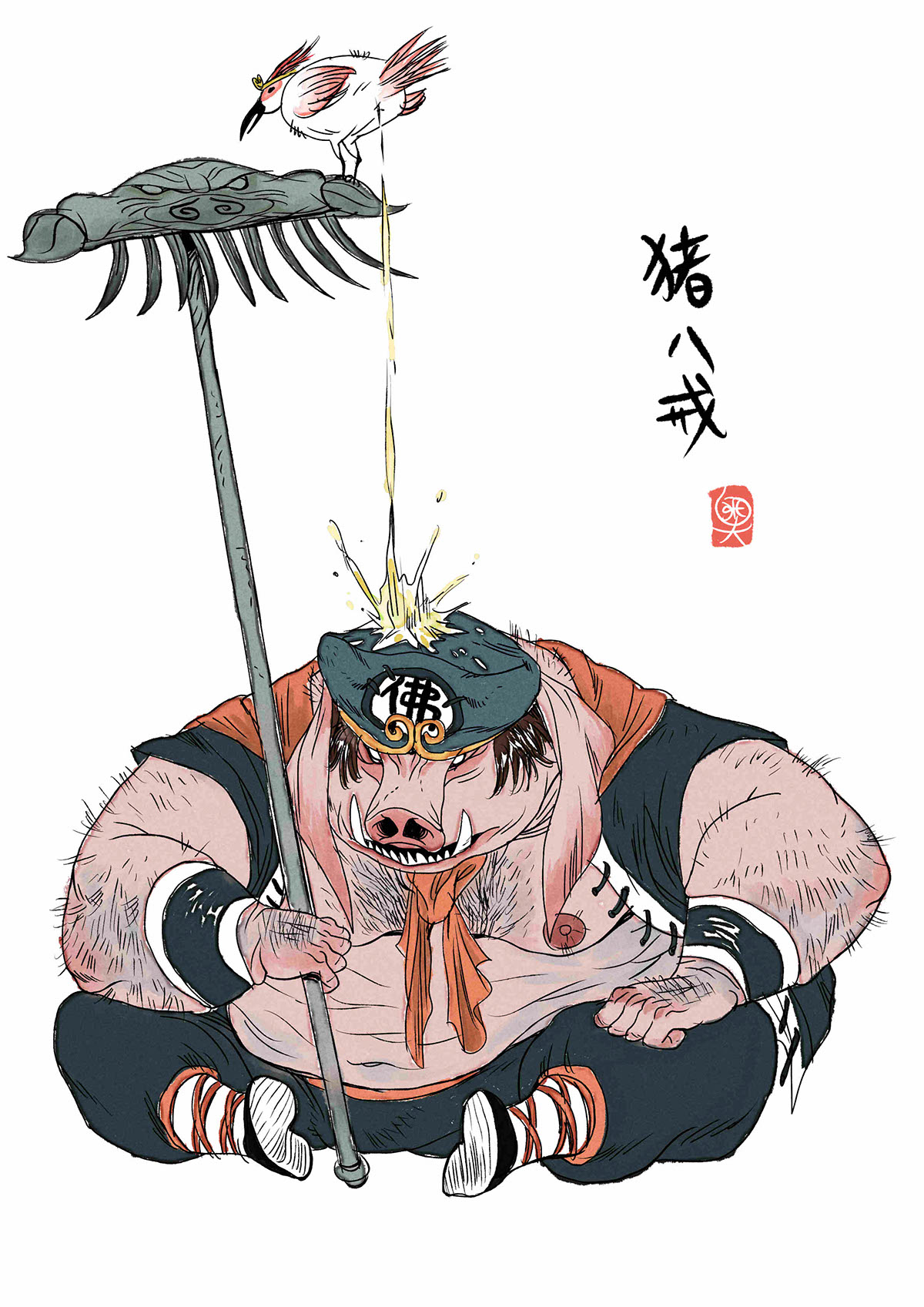
The pig orc is a hybrid, in more ways than one. As a beast-man of some variety, it is some sort of compromise between human and pig: perhaps in its origins some kind of literal hybrid, perhaps a convergent evolution of the boar towards bipedalism and talkativeness, perhaps a bioengineered warrior race, perhaps pigs which have reclaimed the bipedalism and chattyness that jealous men and their gods stole from them at the beginning of time. But in its conceptual use it is also a hybrid between the "orc" as we have received her from Tolkien, warcraft, warhammer, und so weter, and this pig-man. We are aware that the orc is Problematic (arguments to this effect will not be rehashed here; you either know and accept or know and reject them, but I'll be taking them for granted), and prompt reconsideration of paths not taken, such as the forays into the pig orc which our hobby once considered. By doing so we hope to rescue the patrimony of the orc - all the sustained half-lore and ideas that we've built up over the years, orc prayers and orc warfare and all the rest - from the vast condescension of a guilty conscience. Like a dying uncle who made a fortune from assorted bad deeds, or rapping slavers, we want to save the parts we've grown accustomed to and wash our hands of the rest: we want, as we have always wanted, to kill the orc and take her stuff. "Heritage, not hate!"

This is all just an uncharitable and spicy way of saying that the pig orc splits the difference in a productive way: all of the innocence of the cute furry animal races, all of the (salvageable) heritage of the word "orc." (In a vacuum, one could find anthropomorphic races a case of pseudospeciation with a long racist history, but in practice that's not how people read it - we associate talking upright animals with goofier and more forgivable vices - and since we're talking about symbols, how people take it is the truth of the matter.) Moreover, we get mileage out of it: centering "pig" within the name "orc" lets us reflavor and worldbuild our orcs in any number of ways, rethinking them in a new light. (Pigs like to sniff out truffles; what is the relationship between the pig-men and the mushroom-men?)

Moreover this is not just a one-time concept, but a repeatable move. Most obviously, you can consider the other Canonical Fantasy Races. What are the differences between elves that are plants (as in Glorantha), vs. cats, peafowl, jewelry, beta fish? Dwarves that are termites, bats, naked mole rats, mushrooms, automata, pitbulls? Halflings that are frogs, rabbits, potatoes? (And what is the difference between "cat elves" and "catfolk?" Surely that you're injecting some sort of Tolkienian melancholy into the concept of cats.) Ontologically "penguin lizardfolk" (or whatever) becomes possible just as soon as the concept of "lizardfolk" starts exceeding "lizard + folk," outgrows its old suspenders and can be draped in new clothes.

This can be extended further, of course. A farmer wizard breeds and cultivates spells, whereas a dentist wizard notices problems and fixes them painfully. A lion tamer cleric has a different relationship to the gods than a diplomat cleric or your usual fawning servant cleric. A starving artist fighter really cares about their technique in a different way.

How far can this be extended?

Maybe I have just gotten overexcited by the idea of analogies?


顽 形