oragami hexes with landmark/hidden/secret information

This is a practical arts-n-crafts post. It assume you're already familiar with Anne's landmark, hidden, secret terminology (though pedants will note I take some liberties in translating it across media.)

Start by folding a piece of printer paper in half, hotdog-style. This piece of paper will represent one wilderness hex. On the left half, write the "hidden" parts that adventurers will discover if they spend a watch looking through it. On the right half, write anything that they wouldn't.

Here, neither my art nor my adventure design will win any awards, but you've got a functional leaflet where players can open up the first half and peruse without looking at the second.

Fold over the secret side like a second hot dog and seal it with a little bit of easily-removed scotch tape. Then double fold the other side the same way. Then make a little orgami hexagon from it, like so:


On the complex side, draw your landmark information - information everybody gets just by passing through. Here I've indicated that this is a coniferous forest with a river running through it, that it takes 2 movement points to get through, and that it's hex A1. 

I like to think these slot together pretty nicely, even with my total lack of manual dexterity! Have them start on the blank side and get turned over when players enter them, or even add features with a pen that are visible from afar, like mountains and sometimes rivers.

With American letter paper, these work out to about 4.75 inches from corner to opposite corner. If you're using 6-mile hexes, each foot of table space becomes about 15 miles.

veiled rolls and diegetic reasoning

First, some terminology.

Open rolls are what we already call them. Someone makes a roll and the result is announced.

Veiled rolls are rolled, but not announced. However, anybody who wishes to do so could choose to inspect the roll.This is very easy to implement over Discord - just dedicate a channel to it, and maybe sblock the results - but can also be done in analog games.

Secret rolls are not announced and cannot be inspected. This is the classic "roll behind the GM's screen." However, everyone else knows that a roll of some kind is being made. This allows for the tacky possibility of the faux roll, where the GM conspicuously makes a mysterious roll that does nothing.

Personal rolls are made without anyone knowing they are rolled. Rolls made on random tables on prep for inspiration are a classic example.

Generalizing this to the broader class of procedures is left as an exercise for the reader. 

In praise of the veiled roll

A lot of GMing discussions center around the choice between open and secret rolls made by the referee. Even amongst OSR discussions, you have a pretty wide spectrum between "players make all rolls" and "the players shouldn't even know the rules." The former clearly signals that you're not engaging in railroading or illusionism; the latter allows them not pay attention to rules. 

These are, I think, competing tradeoffs to the same end. If we're engaged in a style of play that asks players to "play the world" and use diegetic reasoning, then "if this were a real situation this, but the rules say that" or "if this were a real situation this, but my GM would want to force that" are obstacles. 

What the veiled roll does is both of these:

  • If players want to immerse themselves, they can just not look!
  • If players want to peek behind the curtain, they can!

But best of all, they can just not look, knowing that the threat of peeping is there to keep you honest. Both sides are satisfied. 

How I roll

Here's my current philosophy, going forward.

If the result is something the characters would know, have the players roll it in the open. E.g., "she attacks you for 1d6 damage."

If the characters wouldn't know the results, but you're following a procedure - "does the wizard's magical alarm system alert him of your presence?" - make it veiled. E.g., truth level 2 in blorb philosophy.

Truth level 1 in blorb - the stuff you're artisinally hand-crafting and maybe use a table for inspo - is personal. If you'd reject a roll, it's private. Corresponds to truth level 1 in blorb.

the Summoned (class)

You are a spirit bound to an object of power - perhaps a ring, tome, or crown. Alternatively, you might be bound to something more abstract, such as an office or line of descent, as long as this can be passed from one person to another. Many a “sorcerer” merely binds one such as you, until they meet their doom.

HD: d8

Save and spell progression as wizard/MU.

You must unerringly obey whomever bears your object of power, if they are mortal.

Level up when and only when your mortal master dies stupidly, wastefully, or tragically (allowing you to eat their soul.) You cannot act against them until they make a request of you.

If you die due to HP loss, or if your object is disenchanted, a lose a level and reform at the next full moon. If brought down from first level, permanently reform as an imp or quasit or equally silly little guy. If your fetish is destroyed, or if the bearer of the fetish dies either happily of old age or in genuinely valuable heroic sacrifice, begone for ever.

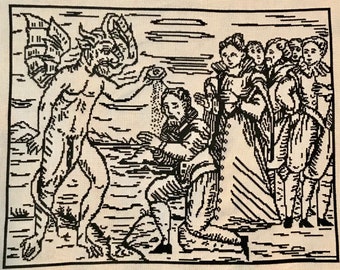
Historic Woodcut the Devil Re Baptising a Male Witch DIGITAL - Etsy UK

d10 (or lower for less weird) fetish

  1. ring
  2. sword
  3. tome
  4. crown
  5. lamp
  6. wand
  7. bloodline
  8. estate
  9. It Follows-style curse
  10. imp bottle
     

d6 spell list (or pick your favorite weird one)

  1. wizard/MU
  2.  cleric (chaotic)
  3. illusionist
  4. necromancer
  5. cleric (lawful)
  6. druid


freeD6 down the line

Lately, I've been convinced that the most useful part of stats is in providing a prompt for you to narratize, and the least useful part is as passive bonuses or interaction buttons. Does an item on your character sheet need to do anything other than that? Millions of people using alignment in 5e say yes. We can go further even than OD&D str/int/wis. We can make ability scores entirely vestigial.

 Here's how you roll ability scores, now:

1. Declare what you're about to roll. It could be strength, or dexterity, or charisma, or your relationship with your mother, or your place on the left-right political spectrum. Anything that fits on a bell curve if you squint. Make sure you declare what high and low are if you haven't already ("left-wing is high, right-wing is low" or whatever.)

2. Roll 3d6 for that score.

3. Repeat as often as you feel like, but no backsies on what you already rolled.

Even if you choose to employ these for bonuses somewhere down the line, this is a balanced method, since you're as likely to be screwed on something as you are to benefit from it. Most importantly, it's simple and fun, which is good if you like high lethality. It also combines well with high lethality because you get some good variety in who you play - a sort of intensification of the virtues of traditional 3d6 down the line.

This may require some clarification about what the average looks like, but if so, that's an opportunity to get on the same page. If I declare I'm rolling "how often they get in trouble with the law" and roll an 11, then we can converse and get a consensus (or dictat from behind the GM's screen) about whether this is a setting where the average person is harassed by the local authorities or basically doesn't interact with them, and so on.

tabletop character generationVariations

1. Combine with it takes a village.

2. Pass it around. Create characters as a group and declare what the person to your right is rolling for. 

3. If it's one person rolling up a replacement PC, let everyone contribute one stat.

4. Roll first, then go through this choices-based system.


d23, week 1

Just copy-pasted notes here - in line with my promise to myself that I can phone this in whenever I want. I have no plan and have not strived for originality, though I do have the goals of the space being one you can navigate through with clues between rooms, and with there being stuff you can interact with.

Hall of transfer and repose

The alveolated walls of this hallway muffle sound.

On one end there is a door to the discussion chamber; a peephole allows one from this room to observe that chamber without being observed in turn.

On the other end there is a door to the curing station.

Another door leads to failed reading room.

On the floor lie a narrow slot that looks like an arrow slit, and a shallow sink into which blood can be poured, wakening the curator of the vampire's library.

discussion chamber

* A **ghoul hound** paws and yips at the wall containing the secret door. It will attack the party if disturbed or if any of them are bleeding
* A sconce on the wall opens a **secret door** to the [[hall of transfer and repose]]
* There is an overturned table, one leg broken off

curing station

An **emaciated corpse** lies upon a table, a **jewel-encrusted knife** (*blade of false death*) lodged in his eye.
- Jars of coagulated blood and **fragrant formaldehyde** lie beneath him.
- If the knife is removed, the corpse will rise as a naked and very confused, and bleeding from the eye, young man. If anyone can speak (*appropriate old language*), or using gestures, he will intimate that he prefers to have the ring on. He is damned, he is certain, for crimes too terrible to mention, and so a permanent version of the fake death granted by the ring is his way of escaping the terrible fate that awaits him in death.

A peephole from here allows one to peer into the [[discussion chamber]], and one can easily open the door to there. One further door leads to the [[torture chamber]], another to the [[embalming chamber]].

embalming chamber

One door leads to the curing station, another to the torturer's study. Niches on the wall house various preserved body parts. These can be consumed per the Monster Overhaul; roll to see what kind of meat is in any particular niche. (1d6: roll on dungeon, thinking beasts, dark and malign, people.)

failed reading room

The door to this room from the [[hall of transfer and repose]] is barred.

Here, the remains of an **obliderated adventurer** radiates from the spot on a desk where he or she was reading a **book of exploding runes** borrowed from the vampire's library.

torture chamber
Various classic implements: iron maiden, thumbscrews, chamber of little comfort.
A vengeful poltergeist resides here and will wait for an attempt to murder the PCs (or anyone else) via the torture implements


Doors lead to the curing station and to the torturer's study.

vampire's library

This room lies beneath the hall of transfer and repose.

Between the hall and the library is an arrow slit a little funnel in which blood or another liquid can be drained; and indeed the floor in teh rivulet is stained thick with blood. In thick inlaid letters in the old lanugage, it says "spill a pint of fresh blood here to speak with the curator, and to borrow one book."

Within the library is an ancient vampire, her mouth agape beneath the "faucet." The pint of blood will awaken her for a day, which she likes to spend reading books in her library. (After a day, languor will set in and she will return to where she can receive blood from library patrons.) Per the terms above, she will lend out one book per pint of blood.

The librarian cannot keep track of time, so there are no due dates per se, but no patron can have more than one book borrowed at a time.

Several books of the vampires have been lost permanently throughout the megadungeon. She will allow borrowings from the special collection (such as rare spell scrolls, or the like) for those who can return these to her. She scribes these spells herself on the skin of any animal, and will also exchange secrets and scrolls for skins.

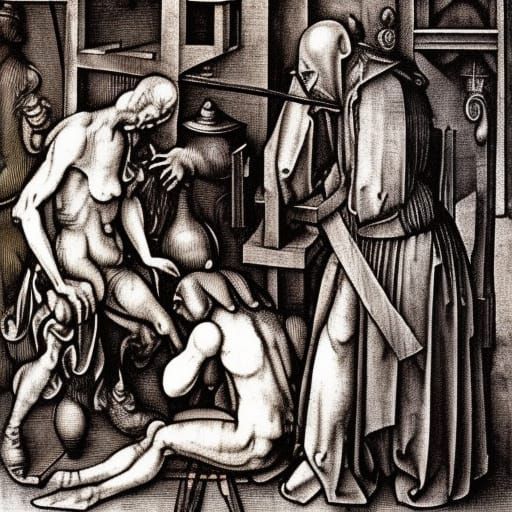
torture chamber by Albrecht Durer and Hieronymous Bosch

prompt: torture chamber by Albrecht Durer and Hieronymous Bosch

theme-agnostic d23 room generator

 I created this for my own use and might as well share it. It won't do any meaningful creative work for you - the results are in fact aggressively boring - but there are already plenty of random tables for that. What this does do is give you a recommended ratio of room stockings in line with the default B/X tables alongside pointing somewhere in your own work to start.

generated via Stable Diffusion with prompt "temple of evil, cross section architectural diagram by Albrecht Durer, Hieronymous Bosch, Gustave Dore"


in which I jump on a bandwagon without a plan

Doing something creative every day is, in the corniest possible sense, nourishing to my soul and so I look forward to this bandwagon.

What I'm not doing is any sort of planning or grand vision at the beginning. I have one room that came to me in the half-dream state of falling asleep, and everything else is just going to be one more room connected to existing rooms.

Process is all that matters. If I write something original, interactive, or compelling, that's nice; If I write "15'x15', orc guards pie for no reason," mission accomplished for the day. Once a connection to the surface is reached, hexes and settlements count as well. 

I'll be using Obsidian for my notebook, and posting results here every so often.  

Stable diffusion; prompt "bottomless pit, architectural diagram by Albrecht Durer and Gustave Dore"


"new game plus" ability score generation

Here's a small way to make dying more fun. 

When you roll up a new character, for each ability score you can either

  1. roll 3d6 raw, or
  2. take (21 - your last character's score in this ability)
  3. cash in a relevant ability score card for a free 16

 When a character dies or retires, you get an ability score card depending on how they did so:

  1. Strength if they died of starvation in the wilderness,
  2. Dexterity if they died of a trap,
  3. Constitution if they died in combat,
  4. Intelligence if they died of a curse, doom, spell, or the like
  5. Wisdom if they retired to settle down with a family, business, or the like
  6. Charisma if they retired to nurse their wounds, too traumatized to either live out an adventurers' or a normal life

If multiple categories apply, choose your favorite. If none apply or if the death is really epic or weird, the GM can come up with an appropriate other kind of boon.

(Combine with ensemble cast ability scores as desired.)

leapfrog tables

Since my last post on eliminative progress tables, I've been playing around with some worldbuilding subgames and it feels a bit less chaotic than I would like. This is an attempt to iterate on the same idea but with a bit less predictability.

A leapfrog table involves more entries than the die used to roll it (for instance, 30 entries on a d6 table) where order matters. Use it as so,

  1. When an entry is rolled, strike it off.
  2. If landing on a stricken entry, roll again, advancing from the stricken entry (multiple times if necessary)

To add "declining marginal returns," you can regard upper levels of the die you're rolling as null results, e.g. roll 1d8, on 1-6 advance that many entries, on 7-8 nothing happens - such that if the first six entries are already filled up you only have a 57% chance of actually adding something, or whatever.

Tech tree adapted from the most recent edition of a popular 4X (1d10, null result on 9-10)

  1. pottery
  2. animal husbandry
  3. mining
  4. sailing
  5. astrology
  6. irrigation
  7. writing
  8. archery
  9. masonry
  10. bronzeworking
  11. wheel
  12. celestial navigation
  13. currency
  14. horseback riding
  15. ironworking
  16. shipbuilding
  17. mathematics
  18. construction
  19. engineering
  20. military tactics
  21. buttress
  22. apprenticeship
  23. stirrups
  24. machinery
  25. alchemy
  26. military engineering
  27. castles
  28. steel
  29. banking
  30. cartography
  31. mass production
  32. printing
  33. square rigging
  34. astronomy
  35. metal casting
  36. seige tactics
  37. gunpowder
  38. industrialization
  39. scientific theory
  40. ballistics
  41. military science
  42. steam power
  43. sanitation
  44. economics
  45. rifling
  46. flight
  47. replaceable parts
  48. bessemmer steel
  49. refining
  50. electricity
  51. radio
  52. chemistry
  53. combustion
  54. advanced flight
  55. rocketry
  56. advanced ballistics
  57. combined arms
  58. plastics
  59. computers
  60. nuclear fission
  61. synthetic materials
  62. telecommunications
  63. satellites
  64. guidance systems
  65. lasers
  66. composites
  67. stealth technology
  68. robotics
  69. nuclear fusion
  70. nanotechnology

goop -> ultrahuman evolution table (1d8)

  1. aging
  2. sex
  3. mouth/anus
  4. mobility
  5. eyes
  6. pain
  7. ability to breathe air
  8. brain
  9. sleep
  10. survival instinct
  11. live birth
  12. hair
  13. walking upright
  14. grasping
  15. vocalization
  16. memory
  17. empathy
  18. display of emotions
  19. reciprocity
  20. dreams
  21. sclera
  22. breastfeeding
  23. menstruation
  24. opposable thumbs
  25. immortal souls
  26. morality
  27. maths
  28. metaphor
  29. music
  30. language
  31. telekinesis
  32. astral projection
  33. telepathy
  34. aura reading
  35. psychic vampirism
  36. personal survival through reincarnation
  37. levitation
  38. Speech of the Gods
  39. body-hopping
  40. conscious control over all physical and mental processes

goop -> anything evolution table (1d20, null result on 16-20)

This can become the ultrahuman evolution table

  1. aging
  2. sex
  3. mouth/anus
  4. mobility
  5. eyes
  6. pain
  7. ability to breathe air
  8. brain
  9. sleep
  10. survival instinct
  11. exoskeleton
  12. flight
  13. bioluminescence
  14. pheremones
  15. venom
  16. ability to survive in vacuum
  17. burrowing
  18. exotic energy source
  19. can see ghosts
  20. darkvision
  21. live birth
  22. hair
  23. walking upright
  24. grasping
  25. vocalization
  26. memory
  27. empathy
  28. display of emotions
  29. reciprocity
  30. dreams
  31. web-spinning
  32. fire-breathing
  33. shapeshifting
  34. parasitic larvae
  35. petrification
  36. magnetic sense
  37. phase shifting
  38. antimagic
  39. explosive
  40. hallucinogenic
  41. sclera
  42. breastfeeding
  43. menstruation
  44. opposable thumbs
  45. immortal souls
  46. morality
  47. maths
  48. metaphor
  49. music
  50. language
  51. telekinesis
  52. astral projection
  53. telepathy
  54. aura reading
  55. psychic vampirism
  56. personal survival through reincarnation
  57. levitation
  58. Speech of the Gods
  59. body-hopping
  60. conscious control over all physical and mental processes

eliminative progress tables

 A d6 table has six entries, right? Not here!

The following sort of table is meant to represent when you have a sequence of events or developments where some things are biased to happen later and indeed can't happen at the start, but where there's still considerable randomness about the exact order, and an expected "early" thing might never kick in. 

To use this table, simply eliminate any results that arise for future rolls, decrementing every future result. Here's a toy example: a goop evolving into something like a person over millions of years:

d4 goop evolution table

  1. mouth and anus
  2. locomotion
  3. brain
  4. eyes
  5. opposable thumbs
  6. rational soul

So l roll 1d4 on the table and get a 1 - my goop is now a heterotroph with ingress and egress for nutrients. The table now looks like this:

  1. locomotion
  2. brain
  3. eyes
  4. opposable thumbs
  5. rational soul

I roll 1d4 again and get a 2 - my sessile coral thing now has a brain, but it can't see or move.

  1. locomotion
  2. eyes
  3. opposable thumbs
  4. rational soul

1d4 on this and I get 4 - they've evolved a rational soul! So now you have a coral that's a full person. Maybe it just contemplates, since it can't really do or observe anything? Maybe these are the brains in vats I've been hearing so much about? Maybe their strange dreams call out to people from the sea, singing of a strange kinship... 

(Note this table could have given us sequences that make even less sense, like getting a rational soul before getting a brain - I would rather roll with and explain such oddities than try to fit everything into a more elaborate sequence.)

Potential uses of this could include:

  • evolution, as in the above, towards people crabs
  • the villain's plans progressing
  • class abilities, especially in your bespoke GLOGhack
  • a civilization progressing up a "tech tree"
  • rewards from a patron for progressively crazier tasks
and so on. I've been thinking about telescopic isotime (which I've just learned is used in Lizardman Diaries' Empyrean Dynasty long before it occurred to me) and am thinking of some millions-year-long minigames involving evolution towards humanish people and millenia-long tech tree development - I'll post rules for those soonish.

the measure of all things

Why measure things in temporal units? 
  1. It makes things concrete, dare I say materialist
  2. It makes things comparable - at least, if a lot of things are measurable in time.
  3. It builds in clocks, which many blog posts have written about as helpful to sandbox play and the avoidance of quantum ogres
What can one measure in time?
  1. Damage - how long you can survive without receiving medical attention
  2. Distance - how long to travel between points on a pointcrawl
  3. Exhaustion - how long it’s been since you got a good night’s rest; how long you can function until you pass out
  4. Mana - how long you need to meditate in a place of power to charge this, or how long the ritual needs to be, or how long a cooldown period you get
  5. Morale - how long a unit  will endure dangerous battle; how long a force will endure crappy conditions marching/camping under hunger/plague/harsh discipline
  6. Obscurity - how many days of research in the library, or buying drinks at bars, are required to uncover this fact
  7. Proficiency - years of training in a skill
  8. Projects - how many person-hours are required to create this
  9. Rarity - a once in a minute/day/year/century event
  10. Relationships - how long someone will care about you before needing the relationship renewed (by, depending on the type of relationship, patronage, or a date night, or whatever)
  11. Resistance - how long you can get beaten up, or hold your breath, or endure ______ before folding
  12. Standard of Living - how many people need to be working full-time to support both you and yourself (okay not technically a unit of time but integrates well with them
  13. Stealth - how long you can do this without someone noticing
  14. Wealth - how many hours of labor are embodied in this
How can one measure things in time?
  1. Openly, so that players can tactically work with it, or secretly, so that they have to guess.
  2. Smoothly, such that you know exactly how long something can take and can put it on Fantasy Calendar or whatever, or stochastically, rolling to see how much things advance or whether the event happens.
  3. (If something doesn’t happen according to visible clocks in reality, being open and smooth is going to feel gamey!)
  4. Using aforesaid Fantasy Calendar, or a physical timer like on your phone or a little hourglass (useful especially if you use some kind of microisotime where the time represented by a combat round is around the time IRL resolve it
What am I missing from any of the above? And what shouldn’t be measured in time?

fictionplay

Here's a bit of theory, or manifesto, or something. It's short and probably thought of by others, because I'm not all that smart, but I think it articulates the kind of roleplay I find most interesting. 

What I am most interested in lies at the intersection of:

  1. fiction that is not stories, in the narrow sense of "story." Stories have a narrative structure, especially one based around a satisfying set of choices that change an individual, with the beginning pregnant with the end; fiction in the sense that I care about is just a set of claims that are consistent with each other but not reality, and which are asserted for interestingness rather than deceit. A description of a cool sword is fiction but not a story. A big setting supplement is also setting but not a story. A campaign that kind of meanders and does a bunch of interesting things may or may not be a story, idk, but it is certainly a fiction.
  2. play that is not games, in the narrow sense of "games." Play in the general sense is ____________ ??????? but "properly" gamelike to the extent that goals are clear and actions are clearly delimited.

Thus, the answer to me re: "are RPGs games" or "are RPGs stories" is that they're neither, but adjacent to both.

OSR-Style Roleplay - what it really means

Is the OSR based on a false origin myth? Should it die? Is it an ineradicable discourse? Has it died already again and again? There are many stories you can craft. 

But unlike you heretics, I don't believe in crafting stories - I believe in procedures. As always, once you roll the dice, you should stick with result forevermore. Once you click on the below button, that's what the OSR is.

alone together: solo tools for trad PBP

Recently, a Knight at the Opera discussed how media stand in the shadow of each other; for instance, how early film served as a simple recording of play-like performances despite the possibilities being so different. I don’t know that there’s any RPG form living more thoroughly in the shadow of its parent than PBP versions of tabletop gaming, with more tragic results: it’s a direct transplant of the GM-player conversation loop that is so often strangled rather quickly when the medium simply doesn’t support it. Traditional RPGs, with their task resolution and strict GM/player division of labor, tend to fare worse than storygames, with their conflict resolution, weak or no role specialization, and oftentimes just explicitly passed around narrative control. OSR-style play falls squarely on the former side of this divide.

But OSR-style play has long emphasized a few ideas, like GM neutrality its enforcement through randomized tables, that mesh well with another style, one that’s been finding its legs recently: solo gaming. OSR procedures and solo oracles fit so well together because they’re a solution to the same goals: providing surprising challenges and the illusion of an independent world. 

But solo gaming is also solving another problem: doing without the conversational loop. (Indeed for solo play the former problems arise from the latter.) Perhaps they’ve progressed faster than PBP on this front because while each exchange from player to GM and back in PBP is achingly expensive, in solo it’s impossible.

The thing, though, is that nothing about oracle use and other solo tools makes having a GM impossible - it only makes impossible the GM who wants to tell a particular story. And a GM can do things an oracle can’t - like playing with secret but consistent information, and so on.

Here’s the general proposal, then: for a PBP game to describable either as 1) an OSR game where players know all or most all of the objective GM procedures and can execute the role of neutral referees themselves, 2) several solo games which take place in the same continuity.

This style can also play nice with:

  1. Pendragon-style personality mechanics for narrating other PCs 
  2. Using multiple systems (say Gary likes combat puzzles and I don’t, so he uses Pathfinder 2e to govern events in his posts and I use B/X or whatever) - since all or most all mechanical loops can be closed within any post, only diegetic continuity matters
  3. Since I keep looking for ways to slot it into everything, using 1:1 time as a regulator of “how much” narration any post should be doing
  4. GMs uploading tables to Perchance, dungeons to twine…
My more specific proposal: if you’d like to do this over the summer - I thinking a sandbox game set in Dolmenwood but can be persuaded into plenty - let me know!


It Takes a Village (ability score generation method)

 Rook asks for people's favorite ways of generating ability scores. Here's mine:

  1. 3d6, down the line.
  2. Give this person a name, something that keeps them busy (rolling on an appropriate background table works!), something they want, and (if this isn't the very first person we know about in this world) a relationship to one other person. Make sure it's all on an index card or a spreadsheet row, but nothing more than that.
  3. Repeat (going around the table as you do so) until everybody's bored of it. 
  4. All of these are now part of your stable of characters. Anybody can choose any and give them a single class level to start.

If you like, you can set things up for generational play by requiring half the rolls to be for minors - roll 2d6 for each stat and when time in the campaign has advanced enough, give them their additional d6 in each stat and make some suppositions about who they've become by that point. 

random factional alignment generator

Why still more posts on alignment? Maybe because as such an inherently slippery concept, there's so many ways to resolve it. Here I want to lean into the idea of alignments as really just being army factions to play Chainmail in. Those of you who grew up as the same time as me will likely recognize exactly where my conception of where Generic Fantasy Army Faction Components comes from.

Xd13 games to run in the same continuity

See previous. Presumably you'd want some kind of secret council chamber where the poor GMs of all of these coordinate everything, but the good news is they hardly have to come up with anything at all. I’ve suggested specialized systems for specialized purposes, but you could just as easily go with a single system that scales well, no system at all, etc.

  1. The gods. Run using some sort of GMless narrative system. The referee team's only privilege is that they get to actually see what the gods are doing (or that there is a god game going on) and interpret the consequences for everywhere else. 
  2. The game of empires. Run as a grand strategy forum game
  3. The Chosen One and/or BBEG. Run as quest and represent their actions through the game of empires.
  4. The marcher warzone. Run using Chainmail or something. Represents a particular front in the game of empires and overrules any more abstract rules present there.
  5. The noble family. Run using Sword Chronicle. Owns a castle in the marcher zone. 
  6. The West Marches. Run using your OSR system of choice (preferably something using domain rules so you can seamlessly scale up.) Keep used by the noble family as base. Probably the most familiar thing going on. Note that any of the above or below may go posting for “jobs” that these may answer.
  7. The village. Run using the above, or Stonetop or Beyond the Wall. Or when paranoia strikes or an inquisition is launched, break out a game of Werewolf. Or for a different feel, The Quiet Year.
  8. Dungeon factions. Run these as another forum game, or via Wicked Ones or something.
  9. Ordinary people swept up in the tragedy of events surrounding them. Run as DCC-style funnels.
  10. The inn. Run as a channel in the inevitable Discord. Let anyone join (perhaps in disguise if appropriate,) 
  11. Shenanigans. All of the above have some boundary expectations. Although 1:1 time is an odd fit for it, an actual traditional table of people meeting once a week provides a fun chaos factor.
  12. Why not? Use Bunnies & Burrows.
  13. Licensing out. Use Shooting the Moon or any number of Solo games or just fiction to tell smaller stories without any referee to adjudicate or really even offer permission.

I’m presuming a cod-medieval extruded fantasy product for proof of concept and because that’s easy to coordinate shared understandings around, but there’s no need for your own megatable’s vision to be so limited. 

d10x10 [adverb] [allegiance] alignments

Posts on the alignment tag on this blog just keep growing, but so far they haven't added up to an kind of project. This post will not add up to anything coherent either. This is similar to my random alignment generator but a little more lightweight - I'd use the former to generate initial ideas for NPCs and this in conjunction with other sources, as perhaps a kind of reaction roll.

style

  1. fanatically
  2. fastidiously
  3. hypocritically
  4. naively
  5. nominally 
  6. self-loathingly
  7. self-righteously
  8. surprisingly 
  9. trying to be
  10. unwittingly

allegiance

  1. traditional
  2. progressive
  3. benevolent
  4. patriotic
  5. selfish
  6. malevolent
  7. communitarian
  8. individualistic
  9. peace-loving
  10. nature-loving

dumb tricks for isotime multilevel West Marches

Ben Milton's recent video on how at least Gygax's version of D&D starts making more sense when you consider the context - a gigantic West Marches with 1:1 time and lots of patron play - has got me curious. With my personal obligations about to be way bigger, I frankly can't do any of this - and I'm cutting way down on polish on these posts to just get out ideas while i still can - i do want to just jot down a bunch of ideas for people to raid as much as possible.

If you do some poking around you'll find there's an existing community around this style, with some interesting ideas worth stealing, but they're abrasive to a degree that 1) offering any condemnation more spirited than that is just offering encouragement, and 2) I'd rather let them continue to be in their corner of social space and they continue to be in theirs. 

The best resource collections that I can find on this date back to about 2012, with Nagora on the AD&D game loop and Chris Kutalik of Hill Cantons on domain play. On the comments to Ben's video, though, you find lots of commenters saying they've been playing this way for decades, so it's clearly not so much lost as lost to us!

Telescopic Isotime

Gygaxian fundamentalist play prescribes 1:1 time - one day IRL equals one day in-world. This forces you to be aware of the passage of time, allows coordination of multiple groups, and - although this is a bit of je ne sais quois - is great for the eerie feeling that the diegesis is another world as legitimate as our own, churning along. 

This is great for individual-level play, where we experience people, but what about the grinding of continents, rise and fall of civilizations, that kind of thing? This amazing Wikipedia article and this suggests one approach - let each day of IRL time be a certain amount of diegetic time, shifting according to a set schedule: 

  • starting very slowly, with days equally diegetic microseconds where new fundmental forces come into play
  • then ramping up as players describe the kinds of matter these form into
  • then going into tens of millions of diegetic years per IRL day as galaxies (or whatever equivalent in the heterophysics you've cooked up) form
  • then millions of years as life evolves...
  • and so on and so forth, with language evolution described and archived with sound change appliers and whatever...
  • up until you're dealing with years, then seasons, then months, then weeks, and finally you've slowed down to 1:1 time

This could be great for worldbuilding! "Organic," aka an absolute mess but in the best possible way.

In particular I suspect a great way to spend the seasons and months would be to great for purposes of building up a stable of NPCs whom you've seen through their childhoods, even generations, and now you're able to zoom in and see them on a human or elf or gretching or whatever level...

Obviously this is insane but maybe you can cobble people together for it via...

use many game systems

Take a cue from Mosaic Strict and cobble together rules systems through diegesis. Use lots of different media entirely. Go to the sufficient velocity quest forums and have them be a god who creates your world, then head over to the grand strategy forum to generate a few centuries of history, deputize regular DMs to run the same shared world using World of Dungeons and Pathfinder 2e and whatever other shit players are into, let anybody who wants to access the maps to play solo play. 

 use Notion to keep track of canon

If you deputize enough then hopefully the whole thing becomes a distributed system, sort of like a blockchain but (insert your own joke here) and so it doesn't depend as much on a single failure point.

For a single auteur GM or worldbuilder Obsidian is probably the best system, because it's open source, but Notion is way easier to share and use with lots of people and you can even give different people access to different parts, and integration with spreadsheets is good. so i would use that

is god real????

A fun thing you could do especially if you have people playing worldbuilding games from the beginning is to have clerical magic work by influencing players who are gods, like, give clerics no spells but do give them a direct line to the gods. (or both, whatever)

okay so then the next phase of this is that you can do this regardless of whether there are any gods or not! you can tell people this and let them guess. They can send petitions to God or the gods and genuinely wonder whether anyone is listening or cares, having suspicions both ways, just like real life!

scryfall generators for follower recruitment

I mean, this isn't specific to any of this. and you'd have to adjust. But you can specify all sorts of things with the Scryfall API, and it's most coherent with creatures by far (like sorceries are sometimes events and sometimes spells and sometimes actions and sometimes who knows what and the diegetic translation never has much to do with anything you can search for, but the tags for creatures are all much more grounded - creatures with higher CMC are "higher level" and humans are humans and so on.) ANYWAY the follower recruitment tables are always very kitchen sink anyway so make them even wackier by inputting a few constraints into a Scryfall oracle.

Assorted links

  1. Chris of Hill Cantons on news as campaign glue

cosmic alignment: Law, Chaos, & Evil

Why?

  • if alignments are cosmic "teams," then three factions are more interesting than two
  • am I saying that Good doesn't exist here? not as that kind of cosmic sports team, is all I'm saying. Goodness already exists in every universe with consciously choosing beings (see: Kant*) so you're letting things slide towards a naturalistic fallacy if you throw in like Goodonium particles or whatever
  • and if you're outright told a team is Good, that's boring. and also teams with that designator tend to be as well - we all know the lower planes sell way better than the higher ones
  • value is plural, really dedicated evil is all the same shit. evil is fundamentally monotonous, always interested in the same fundamental things, fascinating only in the way we can find other repetitive superstimuli fascinating. so one Evil and multiple things that can be good

I realized I accidentally re-created the Werewolf Triat, but I'm okay with that

 Law

  • dangerous (Aslan is not a tame lion)
  • can be good
  • wants you to play a helpful role in building things you didn't really sign onto and might not really understand
  • cosmic realm: you're living in it, baby. notice all these stable laws keeping up up and down down? obviously not completely because the project isn't finished yet, not barely, that's why all the bad and confusing stuff exists obviously, but we'll get there
  • troops and tech: biblically accurate angels, ancient artifacts beneath the earth sending up dreams giving instructions for their repair, a keep with 5d100 men-at-arms clearing out a hex of monsters
  • organization: you might think Law is monotonous and cooperative but in fact in terms of politics Law is the most diverse, pretty much any "system" that can appeal to some idea of the general benefit (communism, neoliberalism, theocracy, even anarcho-whatever if it's like a system for social organization) is Lawful at its core and of course these different things don't necessarily play nice with each other (see realm above and note that this is why multiple universes exist)

Chaos

  • dangerous, in obvious ways
  • can be good
  • wants to make new things, go beyond, slip beyond the boundaries of what presently exists 
  • cosmic realm: everything that hasn't been stitched into a cosmos in a way that law has - Faerie and the dreaming realm are nearby examples, on the periphery of our universe, and from there one can go into the Pure Chaos and perhaps find other islands of Law (to fuck up by bringing in your Out-of-Context Chaotic content)
  • troops and tech: gretchlings, rolling on the mutation table, recruiting 2d20 knaves who then leave, unexpectedly open gates,
  • organization: swarms, forming and splitting

Evil 

  • cannot be good. i mean, any given evil thing might later be good, but Evil cannot be good (duh) except when it's consciously hemmed in as a game or whatever
  • can be dangerous, but also a false feeling of security is one of the ways it sells shit to you
  • moreover. Evil lacks the fundamental danger that Law and Chaos do, because when you sign on to each of the others, you're placing trust and faith in something whose outcomes you can't really know. but if you've felt the pleasures of Evil you've kind of encountered all there is there, and you know what you're getting into
  • not everything immoral is Evil. cheating on your taxes because you want a beach vacation is bad but not Evil. Evil is about the high of omnipotence you get from cruelty and control over others.
  • cosmic realm: big black hole, concentrating power, incapable of seeing beyond itself, confident that it will draw everything into it, and for what? you can feel its rays peircing and its gravity pulling from anywhere in the multiverse, which it feels itself to be the center of, but especially its cosmic projections, dark dungeons where it draws the greedy deeper into darkness
  • troops and tech: turning yourself into a vampire, dumb Lawful troops who think you're the voice of God, sucking someone's soul out and using it to fuel _______
  • organization: Evil has two organizational forms, exoteric fascism and esoteric pyramid schemes. these are both a response to the fact that nobody, including the Evil, actually wants Evil to win in general, nobody benefits from it; so either you set up an organizational structure that allows you to concentrate power and abuse and manipulate innocents, or if you're recruiting people into Evil you're offering them power over these others alongside ways that limit their ability to turn back (you're immortal but you have to suck blood, you can suck my cool vampire blood but you become addicted to that, you've signed a contract that sends your soul straight to hell so hey kid no backing out now, etc). obviously these can be combined in any number of ways

*okay, maybe "read Kant" isn't the best advice because when he's wrong he speaks with all the clarity of your most misguided relative on Facebook and when he's right he speaks with all the clarity of a French literary critic, so uhhhhh read Cathy Korsgaard or something. all i'm saying is that good is doesn't need to give you spells to care about it