a one-pager for NPCs

There are many one-page thingies to print off for generating NPCs; this one (pdf) is mine. Most of the content pilfered and lightly edited from there. 

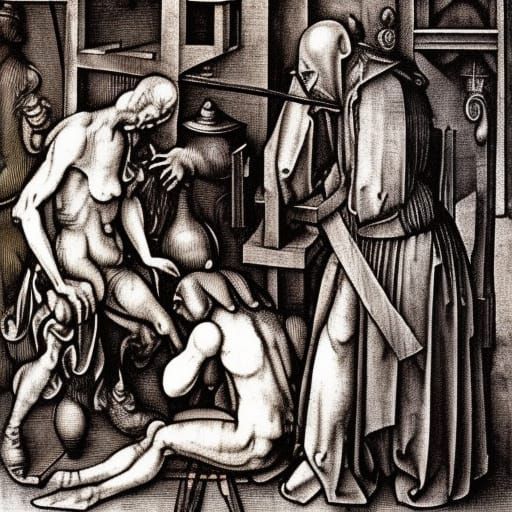
The d66 charts are grouped by theme, so you can roll 1d6 if you're looking for something that fits a broad stereotype, or traits that have that kind of consanance with each other, and the traditional d66 if you don't. The "probable progressions" represent some possibilities for how a problem might develop in the absence of PC intervention. "Manners and motions" is taken from Laban efforts. The Durer is nominally a gender table, but the real purpose is just an image to make it clear which page this is as I flip through my GM's notebook.

Editable version here, if you wish to tailor to your own uses.

the Ersatz King

Another quotepost. 

By 1863 bce, King Sumu-El of Larsa had been dead for three years. Larsa was rising in power and importance under his successor. King Sumu-la-El of Babylon was in his seventeenth year and busily expanding the borders of his own kingdom. Meanwhile, previously dominant Isin faced one defeat after another. And then something remarkable happened there. Or rather, it may have happened. We only know about this episode from a much later chronicle, but the names are right, so perhaps it really took place.

It seems that an eclipse of the moon occurred, terrifying everyone who witnessed it. The Mesopotamians had no way to know that the eclipse happened because the Earth passed between the moon and the sun and cast its shadow across the moon. To Mesopotamian eyes, the bright, reassuring face of the moon gradually seemed to be swallowed up by darkness and was replaced by a round red shadow in the sky. Diviners believed that it signaled the death of the king.

Erra-imitti acted in his own self-interest, and he may have been the first king to come up with a solution to the threat of his imminent death. At any rate, he’s the first one that we know of to do this (there were others who followed his lead in later centuries). According to the later chronicle, “Erra-imitti, the king, installed Enlil-bani, the gardener, as a substitute king on his throne. He placed the royal diadem on his head.”52 The plan was that this gardener, Enlil-bani, would serve as king in place of Erra-imitti—living in the court, being served by attendants—and that the gods could go right ahead and carry out their threat to kill the king, but they would choose the gardener-king instead of the real king, Erra-imitti. Just in case the gods failed to follow their cue, the real king would have the substitute king killed, after which Erra-imitti would retake the throne, the prophecy having been properly fulfilled. This, at least, is what happened in later centuries when a substitute king was installed in order to fulfill, and outwit, a prophecy of death to the king.

But the gods seem to have been wiser than Erra-imitti anticipated. Instead, “Erra-imitti [died] in his palace when he sipped a hot broth. Enlil-bani, who occupied the throne, did not give it up (and) so was sovereign.”53 Fact or fable? It seems like a fairy tale, and yet it may well have happened. There is no record from the time of this remarkable occurrence, only ones that were written much later. But then, not many royal records survive from this period; it might simply be lost. Enlil-bani is unlikely to have bragged in a royal inscription about this odd way of coming to power. Being a gardener was not a normal preparation for the throne, after all.

So perhaps the real king did die, as the gods had foretold with the lunar eclipse. One can imagine Erra-imitti sipping his hot broth and then suddenly falling to the ground. Did he choke to death, or have a heart attack, or was he perhaps even poisoned? At this point the gardener, Enlil-bani, who had been placed on the throne simply as a convenience in order to spare the king, could have justifiably argued that the gods had wanted him to rule. What were the chances? There he was, ready to give up his life for the gods and the kingdom, and suddenly it was clear that he was the gods’ choice, after all. They had seen through Erra-imitti’s ruse and killed him anyway.

In the end, Enlil-bani (1860–1837 bce) left far more evidence of his reign than did the ill-fated Erra-imitti. He commissioned an inscription to be impressed onto the bricks of a building that he constructed in Isin. It began, “Enlil-bani, shepherd who makes everything abundant for Nippur, farmer (who grows) tall grain for Ur,”54 which sounds like a slight nod to his humble agricultural beginnings. But he also claimed religious powers. He “purifies the mes (cosmic truths) of (the city of) Eridu,” and was the “favorite en-priest of Uruk.” At this point he came to his titles: “king of Isin, king of the land of Sumer and Akkad,” the latter being the title given to the kings who claimed to control all of Mesopotamia. He was their rightful successor. Note that, unlike most kings, he didn’t name his father. Why would he? His father had not been royal. Instead he emphasized that he was the “spouse chosen by the heart of the goddess Inana.” And, like Erra-imitti and the other kings of Isin before him, Enlil-bani added the divine symbol in front of his name. Notwithstanding his humble start in life, he asserted that he was himself a god, an appropriate husband for the goddess Inana.

No commentary because this - from Amanda Podany's lovely Weavers, Scribes, and Kings - stands as gamefuel on its own.

the damnation song (OSR-style challenge)

There is a certain ritual which a particular religious order insists must be performed continuously, generation upon generation unto infinity. For it to be interrupted for even a second would be a kind of disaster, albeit one which insists must be corrected as quickly as possible, not the kind that ends the world.

For present purposes, the details of the ritual itself aren't important, although for gameability it might do well for the ritual's continually evolving needs to require either something horrible or difficult to acquire. Inquiring PCs might first note that the religious order is cagey about what goes on and why, and further furtive inquiries show devil masks and other stereotypical Evil Cult Aesthetics.

The ritual is connected to a hell realm. What it does it keep the hell realm lulled into stasis. When the ritual - which is a sort of mock continuation of the realm - pauses, the tortures of the hell resume. When the ritual resumes, time in the hell realm pauses. There are at least several thousand beings ready to get tortured in there.

You get sent to the hell realm when you die, if and only if you know about it and the purpose of the ritual, and you pass on that knowledge to anybody else.

some (imperfect) resources for smell description

Smells! They play a distinctly tertiary role compared to sight and sound, so central to the mechanically reproducible media of our age. When you bring smell into your description at the table, you really bring an oomph that stirs players out of their cinematic slumber. But precisely because it's less available, it's also harder to get the tools to describe it. Even if I've never seen a dragon, I've seen a million videos of tigers and falcons, but I have a terrible sense of smell and it's been years since I owned a reptile, so that aspect might be a bit harder to do off the cuff.

What I really want is a, like, smell encyclopedia - a big scratch n sniff book where if you want to know what, say, camphor or dillweed smell like, you can just look it up and inhale. I can't find such a thing (if anyone knows, you have my eternal thanks.) But the closest I can find is the Odeuropa smell explorer

It's just on the edge of useability - you'll find stuff that should be gameable, like an alchemist's lab, and there will be firsthand accounts - but it's hard to navigate and the accounts are often not as useful as they could be - describing things simply as good, bad, suprising, or the like isn't uncommon, or everything will be in Italian, or whatever, and yeah automatic translation is a thing but that's another set of clicks... why am I sharing this bad resource with you? Because it's so close to being so good; my way of interfacing with it must just be off a bit. One of you, I am sure, it will click just right for.

This article claims to have found ten basic smells (analogous to the sweet-savory-salty-sour-bitter division), I don't know the math to critique their math and I'm guessing their report data is biased towards a WEIRD sample that is used to e.g. lemony scents being used in cleaning products. But it's the same biased sample that I and the people I'm likely to game with are drawn from, so it's potentially useful for gameable description - this list will probably end up on my GM's screen at some point:

  1. floral, perfumey
  2. woody, musty
  3. fruity (but not in a citrusy way)
  4. rotten
  5. chemical, alcoholic
  6. minty
  7. sweet
  8. nutty, smoky, popcorn
  9. chemical, onion, gas, decay
  10. citrusy

I'm never going to remember a list of ten things, so here's them in even more arbitrary categories:

  • fragrant
    1. floral, perfumey (factor I)
    2. fruity (factor III)
    3. minty (factor VI)
    4. citrusy (factor X)
       
  • tasty
    1. woody, musty (factor II)
    2. sweet (factor VII)
    3. fireplace (factor VIII)
       
  • gross
    1. rotten (factor IV)
    2. ethery (factor V)
    3. gas leak (factor IX)


Magritte, self-portrait


the Dead Christ Proclaims that there Is No God

Not directly RPG related, but here's a great little bit that I discovered from this interview about the history of nihilism. The wrapping device is "dear reader, I apologize for writing something so blasphemous... whew well thank heavens that isn't true at all." I guess that's the sort of groveling you have to do back then if you write something with as metal a title as the Dead Christ Proclaims that There Is No God:

The rattle of the wheels of the clock running down as it was striking eleven, had awakened me. I looked for the sun in the dark and void night sky, for I supposed that some eclipse was hiding it with the moon. And all the graves were open, and the iron doors of the charnel-house kept opening and shutting, moved by invisible hands. Athwart the walls shadows went flitting; but no bodies cast those shadows and there were others, too, moving about out in the open air. Within the open coffins there were none now asleep, except the children. Nothing was in the sky but sultry fog, heavy and grey, ranging there in great clammy folds; and some gigantic shadow closed and closed this fog as in a net, and drew it ever nearer, closer, and hotter. Up overhead I heard the thunder of distant avalanches, and beneath my feet the first footfalls of a boundless earthquake. The church was heaved and shaken to and fro by two terrific discords striving in it, beating in stormy effort to attain harmonious resolution. Now and then a greyish glimmer passed with rapid gleam flittering athwart the windows; but, whenever this glimmer came, the lead and iron of the frames always melted and ran rolling down. The fog’s net, and the quaking of the earth, drove me into the temple, past gleaming, glittering basilisks, brooding in poison-nests beside the door. I passed among shadows, strange and unknown to me; but they all bore the impress of the centuries. These shadows stood all grouped about the altar, and their breasts quivered and throbbed—their breasts but not their hearts. There was but one of the dead still lying on his pillow, and he was one who had but just been buried in the church; he lay at peace, his breast without a throb, a happy dream upon his smiling face. But now, as I came in (I, one of the living), his sleep broke, he awoke, and smiled no more; with painful effort he raised his heavy eyelids—and there was no eye beneath—and in his beating breast there was no heart, but a deep wound instead. He raised his hands, folded as it for prayer; but then his arms shot out and came apart from his poor trunk, the folded hands came off and fell away. Upon the dome above there was inscribed the dial of eternity—but figures there were none, and the dial itself was its own gnomon; a great black finger was pointing at it, and the dead strove hard to read the time upon it.

And at this point a lofty, noble form, bearing the impress of eternal sorrow, came sinking down towards our group, and rested on the altar; whereupon all the dead cried out, “Christ! Is there no God?”

He answered, “There is none.”

At this the dead quivered and trembled; but now it was not their breasts alone that throbbed; the quivering ran all through the shadows, so that one by one the shudder shook them into nothingness. And Christ spake on, saying, “I have traversed the worlds, I have risen to the suns, with the milky ways I have passed athwart the great waste spaces of the sky; there is no God. And I descended to where the very shadow cast by Being dies out and ends, and I gazed out into the gulf beyond, and cried, ‘Father, where art Thou?’ But answer came there none, save the eternal storm which rages on, controlled by none; and towards the west, above the chasm, a gleaming rainbow hung, but there was no sun to give it birth, and so it sank and fell by drops into the gulf. And when I looked up to the boundless universe for the Divine eye, behold, it glared at me from out a socket, empty and bottomless. Over the face of chaos brooded Eternity, chewing it for ever, again and yet again. Shriek on, then, discords, shatter the shadows with your shrieking din, for He is not!”

The pale and colourless shades flickered away to nothingness, as frosty fog dissolves before warm breath, and all grew void. Ah! then the dead children, who had been asleep out in the graves, awoke, and came into the temple, and fell down before the noble form (a sight to rend one’s heart), and cried, “Jesus, have we no Father?” He made answer, with streaming tears, “We are orphans all, both I and ye. We have no Father.”

Then the discords clashed and clanged more harshly yet; the shivering walls of the temple parted asunder, and the temple and the children sank—the earth and sun sank with them—and the boundless fabric of the universe sank down before us, while high on the summit of immeasurable nature Jesus stood and gazed upon the sinking universe, besprent with thousand suns, and like a mine dug in the face of black eternal night; the suns being miners’ lamps, and the milky way the veins of silvery ore.

And as he gazed upon the grinding mass of worlds, the wild torch dance of starry will-o’-the-wisps, and all the coral banks of throbbing hearts—and saw how world by world shook forth its glimmering souls on to the Ocean of Death—then He, sublime, loftiest of finite beings, raised his eyes towards the nothingness and boundless void, saying, “Oh dead, dumb, nothingness! necessity endless and chill! Oh! mad unreasoning Chance—when will ye dash this fabric into atoms, and me too? Chance, knowest thou—thou knowest not—when thou dost march, hurricane-winged, amid the whirling snow of stars, extinguishing sun after sun upon thy onward way, and when the sparkling dew of constellations ceases to gleam, as thou dost pass them by? How every soul in this great corpse-trench of an universe is utterly alone? I am alone—none by me—O Father, Father! where is that boundless breast of thine, that I may rest upon it? Alas! if every soul be its own father and creator, why shall it not be its own destroying angel too? Is this a man still near me? Wretched being! That petty life of thine is but the sigh of nature, or the echo of that sigh. Your wavering cloudy forms are but reflections of rays cast by a concave mirror upon the clouds of dust which shroud your world—dust which is dead men’s ashes. Look ye down into the chasm athwart the face of which the ash-clouds float and fly. A mist of worlds rises up from the Ocean of Death; the future is a gathering cloud, the present a falling vapour. Dost thou see and know thy earth?”

Here Christ looked downward, and his eyes grew full of tears, and he spake on, and said, “Alas! I, too, was once of that poor earth; then I was happy, then I still possessed my infinite Father, and I could look up from the hills with joy to the boundless heaven, and I could cry even in the bitterness of death, ‘My Father, take thy Son from out this bleeding earthly shell, and lift Him to thy heart.’ Alas! too happy dwellers upon earth, ye still believe in Him. Your sun, it may be, is setting at this hour, and amid flowers and brilliance, and with tears ye sink upon your knees, and, lifting up your hands in rapturous joy, ye cry each one aloud up to the open heavens, ‘Oh Father, infinite, eternal, hear! Thou knowest me in all my littleness, even as Thou knowest all things, and Thou seest my wounds and sorrows, and Thou wilt receive me after death and soothe and heal them all.’ Alas! unhappy souls! For after death these wounds will not be healed. But when the sad and weary lays down his worn and wounded frame upon the earth to sleep towards a fairer brighter morn all truth, goodness and joy,—behold! he awakes amid a howling chaos, in a night endless and everlasting; and no morning dawns, there is no healing hand, no everlasting Father. Oh, mortal, who standest near, if still thou breathest the breath of life, worship and pray to Him, or else thou losest Him for evermore.”

And I fell down and peered into the shining mass of worlds, and beheld the coils of the great serpent of eternity all twined about those worlds; these mighty coils began to writhe and rise, and then again they tightened and contracted, folding round the universe twice as closely as before; they wound about all nature in thousandfolds, and crashed the worlds together, and crushed down the boundless temple to a little churchyard chapel. And all grew narrow, and dark, and terrible. And then a great immeasurable bell began to swing in act to toll the last hour of Time, and shatter the fabric of the universe to countless atoms,

So, tl;dr, Christ comes back to Earth, says God is dead, everyone loses their fucking minds, Christ looks out on the cosmos knowing it will die in nothing, the end (or at least the end of the interesting parts).

One, boring genealogical questions: was Richter an influence on Lovecraft? Was he the first to play with some of these tropes?

Two: this is just so great! It's a set of motifs you normally just don't see together that work so well with their incongruity: it's judgment day, the final trumpet is sung, the dead crowd into church with their spectral bodies overlapping and their rotting faces sliding off of their skulls, and Christ comes down from Heaven to state the fundamental truth of the universe, which is that nothing matters and we should all die in horror. 

Three: I think that there's something actually kind of accurate about this incongruity. Two pretty typical models you might have are Jesus vs Satan, or 1 vs. -1, or perfect good vs. perfect evil, on one hand, and on the other 0, Cthulhu, nihilism.

0 vs. 1 is more accurate, more true to real struggle. Per Kant, morality arises from the structure of rationality and agency, but per modern science rationality and agency are the result of atoms smashing into each other from a universe blindly following completely arbitrary and amoral laws. My intuition from hearing a lot people talk about their moral experiences is that basically all of us, regardless of our metaphysics, feel this pull between very high moral aspirations and that everything is completely meaningless and pointless. Active malevolence is by contrast pretty rare and mostly a projection. I wouldn't agree with Augustine that all disvalue is the absence of something good - pointless involuntary pain, the most obvious case of disvalue, isn't the absence of something else - but the Devil, I think, is less real than Yog-Sothoth is.


oragami hexes with landmark/hidden/secret information

This is a practical arts-n-crafts post. It assume you're already familiar with Anne's landmark, hidden, secret terminology (though pedants will note I take some liberties in translating it across media.)

Start by folding a piece of printer paper in half, hotdog-style. This piece of paper will represent one wilderness hex. On the left half, write the "hidden" parts that adventurers will discover if they spend a watch looking through it. On the right half, write anything that they wouldn't.

Here, neither my art nor my adventure design will win any awards, but you've got a functional leaflet where players can open up the first half and peruse without looking at the second.

Fold over the secret side like a second hot dog and seal it with a little bit of easily-removed scotch tape. Then double fold the other side the same way. Then make a little orgami hexagon from it, like so:


On the complex side, draw your landmark information - information everybody gets just by passing through. Here I've indicated that this is a coniferous forest with a river running through it, that it takes 2 movement points to get through, and that it's hex A1. 

I like to think these slot together pretty nicely, even with my total lack of manual dexterity! Have them start on the blank side and get turned over when players enter them, or even add features with a pen that are visible from afar, like mountains and sometimes rivers.

With American letter paper, these work out to about 4.75 inches from corner to opposite corner. If you're using 6-mile hexes, each foot of table space becomes about 15 miles.

veiled rolls and diegetic reasoning

First, some terminology.

Open rolls are what we already call them. Someone makes a roll and the result is announced.

Veiled rolls are rolled, but not announced. However, anybody who wishes to do so could choose to inspect the roll.This is very easy to implement over Discord - just dedicate a channel to it, and maybe sblock the results - but can also be done in analog games.

Secret rolls are not announced and cannot be inspected. This is the classic "roll behind the GM's screen." However, everyone else knows that a roll of some kind is being made. This allows for the tacky possibility of the faux roll, where the GM conspicuously makes a mysterious roll that does nothing.

Personal rolls are made without anyone knowing they are rolled. Rolls made on random tables on prep for inspiration are a classic example.

Generalizing this to the broader class of procedures is left as an exercise for the reader. 

In praise of the veiled roll

A lot of GMing discussions center around the choice between open and secret rolls made by the referee. Even amongst OSR discussions, you have a pretty wide spectrum between "players make all rolls" and "the players shouldn't even know the rules." The former clearly signals that you're not engaging in railroading or illusionism; the latter allows them not pay attention to rules. 

These are, I think, competing tradeoffs to the same end. If we're engaged in a style of play that asks players to "play the world" and use diegetic reasoning, then "if this were a real situation this, but the rules say that" or "if this were a real situation this, but my GM would want to force that" are obstacles. 

What the veiled roll does is both of these:

  • If players want to immerse themselves, they can just not look!
  • If players want to peek behind the curtain, they can!

But best of all, they can just not look, knowing that the threat of peeping is there to keep you honest. Both sides are satisfied. 

How I roll

Here's my current philosophy, going forward.

If the result is something the characters would know, have the players roll it in the open. E.g., "she attacks you for 1d6 damage."

If the characters wouldn't know the results, but you're following a procedure - "does the wizard's magical alarm system alert him of your presence?" - make it veiled. E.g., truth level 2 in blorb philosophy.

Truth level 1 in blorb - the stuff you're artisinally hand-crafting and maybe use a table for inspo - is personal. If you'd reject a roll, it's private. Corresponds to truth level 1 in blorb.

the Summoned (class)

You are a spirit bound to an object of power - perhaps a ring, tome, or crown. Alternatively, you might be bound to something more abstract, such as an office or line of descent, as long as this can be passed from one person to another. Many a “sorcerer” merely binds one such as you, until they meet their doom.

HD: d8

Save and spell progression as wizard/MU.

You must unerringly obey whomever bears your object of power, if they are mortal.

Level up when and only when your mortal master dies stupidly, wastefully, or tragically (allowing you to eat their soul.) You cannot act against them until they make a request of you.

If you die due to HP loss, or if your object is disenchanted, a lose a level and reform at the next full moon. If brought down from first level, permanently reform as an imp or quasit or equally silly little guy. If your fetish is destroyed, or if the bearer of the fetish dies either happily of old age or in genuinely valuable heroic sacrifice, begone for ever.

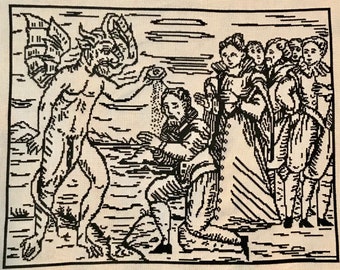
Historic Woodcut the Devil Re Baptising a Male Witch DIGITAL - Etsy UK

d10 (or lower for less weird) fetish

  1. ring
  2. sword
  3. tome
  4. crown
  5. lamp
  6. wand
  7. bloodline
  8. estate
  9. It Follows-style curse
  10. imp bottle
     

d6 spell list (or pick your favorite weird one)

  1. wizard/MU
  2.  cleric (chaotic)
  3. illusionist
  4. necromancer
  5. cleric (lawful)
  6. druid


freeD6 down the line

Lately, I've been convinced that the most useful part of stats is in providing a prompt for you to narratize, and the least useful part is as passive bonuses or interaction buttons. Does an item on your character sheet need to do anything other than that? Millions of people using alignment in 5e say yes. We can go further even than OD&D str/int/wis. We can make ability scores entirely vestigial.

 Here's how you roll ability scores, now:

1. Declare what you're about to roll. It could be strength, or dexterity, or charisma, or your relationship with your mother, or your place on the left-right political spectrum. Anything that fits on a bell curve if you squint. Make sure you declare what high and low are if you haven't already ("left-wing is high, right-wing is low" or whatever.)

2. Roll 3d6 for that score.

3. Repeat as often as you feel like, but no backsies on what you already rolled.

Even if you choose to employ these for bonuses somewhere down the line, this is a balanced method, since you're as likely to be screwed on something as you are to benefit from it. Most importantly, it's simple and fun, which is good if you like high lethality. It also combines well with high lethality because you get some good variety in who you play - a sort of intensification of the virtues of traditional 3d6 down the line.

This may require some clarification about what the average looks like, but if so, that's an opportunity to get on the same page. If I declare I'm rolling "how often they get in trouble with the law" and roll an 11, then we can converse and get a consensus (or dictat from behind the GM's screen) about whether this is a setting where the average person is harassed by the local authorities or basically doesn't interact with them, and so on.

tabletop character generationVariations

1. Combine with it takes a village.

2. Pass it around. Create characters as a group and declare what the person to your right is rolling for. 

3. If it's one person rolling up a replacement PC, let everyone contribute one stat.

4. Roll first, then go through this choices-based system.


d23, week 1

Just copy-pasted notes here - in line with my promise to myself that I can phone this in whenever I want. I have no plan and have not strived for originality, though I do have the goals of the space being one you can navigate through with clues between rooms, and with there being stuff you can interact with.

Hall of transfer and repose

The alveolated walls of this hallway muffle sound.

On one end there is a door to the discussion chamber; a peephole allows one from this room to observe that chamber without being observed in turn.

On the other end there is a door to the curing station.

Another door leads to failed reading room.

On the floor lie a narrow slot that looks like an arrow slit, and a shallow sink into which blood can be poured, wakening the curator of the vampire's library.

discussion chamber

* A **ghoul hound** paws and yips at the wall containing the secret door. It will attack the party if disturbed or if any of them are bleeding
* A sconce on the wall opens a **secret door** to the [[hall of transfer and repose]]
* There is an overturned table, one leg broken off

curing station

An **emaciated corpse** lies upon a table, a **jewel-encrusted knife** (*blade of false death*) lodged in his eye.
- Jars of coagulated blood and **fragrant formaldehyde** lie beneath him.
- If the knife is removed, the corpse will rise as a naked and very confused, and bleeding from the eye, young man. If anyone can speak (*appropriate old language*), or using gestures, he will intimate that he prefers to have the ring on. He is damned, he is certain, for crimes too terrible to mention, and so a permanent version of the fake death granted by the ring is his way of escaping the terrible fate that awaits him in death.

A peephole from here allows one to peer into the [[discussion chamber]], and one can easily open the door to there. One further door leads to the [[torture chamber]], another to the [[embalming chamber]].

embalming chamber

One door leads to the curing station, another to the torturer's study. Niches on the wall house various preserved body parts. These can be consumed per the Monster Overhaul; roll to see what kind of meat is in any particular niche. (1d6: roll on dungeon, thinking beasts, dark and malign, people.)

failed reading room

The door to this room from the [[hall of transfer and repose]] is barred.

Here, the remains of an **obliderated adventurer** radiates from the spot on a desk where he or she was reading a **book of exploding runes** borrowed from the vampire's library.

torture chamber
Various classic implements: iron maiden, thumbscrews, chamber of little comfort.
A vengeful poltergeist resides here and will wait for an attempt to murder the PCs (or anyone else) via the torture implements


Doors lead to the curing station and to the torturer's study.

vampire's library

This room lies beneath the hall of transfer and repose.

Between the hall and the library is an arrow slit a little funnel in which blood or another liquid can be drained; and indeed the floor in teh rivulet is stained thick with blood. In thick inlaid letters in the old lanugage, it says "spill a pint of fresh blood here to speak with the curator, and to borrow one book."

Within the library is an ancient vampire, her mouth agape beneath the "faucet." The pint of blood will awaken her for a day, which she likes to spend reading books in her library. (After a day, languor will set in and she will return to where she can receive blood from library patrons.) Per the terms above, she will lend out one book per pint of blood.

The librarian cannot keep track of time, so there are no due dates per se, but no patron can have more than one book borrowed at a time.

Several books of the vampires have been lost permanently throughout the megadungeon. She will allow borrowings from the special collection (such as rare spell scrolls, or the like) for those who can return these to her. She scribes these spells herself on the skin of any animal, and will also exchange secrets and scrolls for skins.

torture chamber by Albrecht Durer and Hieronymous Bosch

prompt: torture chamber by Albrecht Durer and Hieronymous Bosch

theme-agnostic d23 room generator

 I created this for my own use and might as well share it. It won't do any meaningful creative work for you - the results are in fact aggressively boring - but there are already plenty of random tables for that. What this does do is give you a recommended ratio of room stockings in line with the default B/X tables alongside pointing somewhere in your own work to start.

generated via Stable Diffusion with prompt "temple of evil, cross section architectural diagram by Albrecht Durer, Hieronymous Bosch, Gustave Dore"


in which I jump on a bandwagon without a plan

Doing something creative every day is, in the corniest possible sense, nourishing to my soul and so I look forward to this bandwagon.

What I'm not doing is any sort of planning or grand vision at the beginning. I have one room that came to me in the half-dream state of falling asleep, and everything else is just going to be one more room connected to existing rooms.

Process is all that matters. If I write something original, interactive, or compelling, that's nice; If I write "15'x15', orc guards pie for no reason," mission accomplished for the day. Once a connection to the surface is reached, hexes and settlements count as well. 

I'll be using Obsidian for my notebook, and posting results here every so often.  

Stable diffusion; prompt "bottomless pit, architectural diagram by Albrecht Durer and Gustave Dore"


"new game plus" ability score generation

Here's a small way to make dying more fun. 

When you roll up a new character, for each ability score you can either

  1. roll 3d6 raw, or
  2. take (21 - your last character's score in this ability)
  3. cash in a relevant ability score card for a free 16

 When a character dies or retires, you get an ability score card depending on how they did so:

  1. Strength if they died of starvation in the wilderness,
  2. Dexterity if they died of a trap,
  3. Constitution if they died in combat,
  4. Intelligence if they died of a curse, doom, spell, or the like
  5. Wisdom if they retired to settle down with a family, business, or the like
  6. Charisma if they retired to nurse their wounds, too traumatized to either live out an adventurers' or a normal life

If multiple categories apply, choose your favorite. If none apply or if the death is really epic or weird, the GM can come up with an appropriate other kind of boon.

(Combine with ensemble cast ability scores as desired.)

leapfrog tables

Since my last post on eliminative progress tables, I've been playing around with some worldbuilding subgames and it feels a bit less chaotic than I would like. This is an attempt to iterate on the same idea but with a bit less predictability.

A leapfrog table involves more entries than the die used to roll it (for instance, 30 entries on a d6 table) where order matters. Use it as so,

  1. When an entry is rolled, strike it off.
  2. If landing on a stricken entry, roll again, advancing from the stricken entry (multiple times if necessary)

To add "declining marginal returns," you can regard upper levels of the die you're rolling as null results, e.g. roll 1d8, on 1-6 advance that many entries, on 7-8 nothing happens - such that if the first six entries are already filled up you only have a 57% chance of actually adding something, or whatever.

Tech tree adapted from the most recent edition of a popular 4X (1d10, null result on 9-10)

  1. pottery
  2. animal husbandry
  3. mining
  4. sailing
  5. astrology
  6. irrigation
  7. writing
  8. archery
  9. masonry
  10. bronzeworking
  11. wheel
  12. celestial navigation
  13. currency
  14. horseback riding
  15. ironworking
  16. shipbuilding
  17. mathematics
  18. construction
  19. engineering
  20. military tactics
  21. buttress
  22. apprenticeship
  23. stirrups
  24. machinery
  25. alchemy
  26. military engineering
  27. castles
  28. steel
  29. banking
  30. cartography
  31. mass production
  32. printing
  33. square rigging
  34. astronomy
  35. metal casting
  36. seige tactics
  37. gunpowder
  38. industrialization
  39. scientific theory
  40. ballistics
  41. military science
  42. steam power
  43. sanitation
  44. economics
  45. rifling
  46. flight
  47. replaceable parts
  48. bessemmer steel
  49. refining
  50. electricity
  51. radio
  52. chemistry
  53. combustion
  54. advanced flight
  55. rocketry
  56. advanced ballistics
  57. combined arms
  58. plastics
  59. computers
  60. nuclear fission
  61. synthetic materials
  62. telecommunications
  63. satellites
  64. guidance systems
  65. lasers
  66. composites
  67. stealth technology
  68. robotics
  69. nuclear fusion
  70. nanotechnology

goop -> ultrahuman evolution table (1d8)

  1. aging
  2. sex
  3. mouth/anus
  4. mobility
  5. eyes
  6. pain
  7. ability to breathe air
  8. brain
  9. sleep
  10. survival instinct
  11. live birth
  12. hair
  13. walking upright
  14. grasping
  15. vocalization
  16. memory
  17. empathy
  18. display of emotions
  19. reciprocity
  20. dreams
  21. sclera
  22. breastfeeding
  23. menstruation
  24. opposable thumbs
  25. immortal souls
  26. morality
  27. maths
  28. metaphor
  29. music
  30. language
  31. telekinesis
  32. astral projection
  33. telepathy
  34. aura reading
  35. psychic vampirism
  36. personal survival through reincarnation
  37. levitation
  38. Speech of the Gods
  39. body-hopping
  40. conscious control over all physical and mental processes

goop -> anything evolution table (1d20, null result on 16-20)

This can become the ultrahuman evolution table

  1. aging
  2. sex
  3. mouth/anus
  4. mobility
  5. eyes
  6. pain
  7. ability to breathe air
  8. brain
  9. sleep
  10. survival instinct
  11. exoskeleton
  12. flight
  13. bioluminescence
  14. pheremones
  15. venom
  16. ability to survive in vacuum
  17. burrowing
  18. exotic energy source
  19. can see ghosts
  20. darkvision
  21. live birth
  22. hair
  23. walking upright
  24. grasping
  25. vocalization
  26. memory
  27. empathy
  28. display of emotions
  29. reciprocity
  30. dreams
  31. web-spinning
  32. fire-breathing
  33. shapeshifting
  34. parasitic larvae
  35. petrification
  36. magnetic sense
  37. phase shifting
  38. antimagic
  39. explosive
  40. hallucinogenic
  41. sclera
  42. breastfeeding
  43. menstruation
  44. opposable thumbs
  45. immortal souls
  46. morality
  47. maths
  48. metaphor
  49. music
  50. language
  51. telekinesis
  52. astral projection
  53. telepathy
  54. aura reading
  55. psychic vampirism
  56. personal survival through reincarnation
  57. levitation
  58. Speech of the Gods
  59. body-hopping
  60. conscious control over all physical and mental processes

eliminative progress tables

 A d6 table has six entries, right? Not here!

The following sort of table is meant to represent when you have a sequence of events or developments where some things are biased to happen later and indeed can't happen at the start, but where there's still considerable randomness about the exact order, and an expected "early" thing might never kick in. 

To use this table, simply eliminate any results that arise for future rolls, decrementing every future result. Here's a toy example: a goop evolving into something like a person over millions of years:

d4 goop evolution table

  1. mouth and anus
  2. locomotion
  3. brain
  4. eyes
  5. opposable thumbs
  6. rational soul

So l roll 1d4 on the table and get a 1 - my goop is now a heterotroph with ingress and egress for nutrients. The table now looks like this:

  1. locomotion
  2. brain
  3. eyes
  4. opposable thumbs
  5. rational soul

I roll 1d4 again and get a 2 - my sessile coral thing now has a brain, but it can't see or move.

  1. locomotion
  2. eyes
  3. opposable thumbs
  4. rational soul

1d4 on this and I get 4 - they've evolved a rational soul! So now you have a coral that's a full person. Maybe it just contemplates, since it can't really do or observe anything? Maybe these are the brains in vats I've been hearing so much about? Maybe their strange dreams call out to people from the sea, singing of a strange kinship... 

(Note this table could have given us sequences that make even less sense, like getting a rational soul before getting a brain - I would rather roll with and explain such oddities than try to fit everything into a more elaborate sequence.)

Potential uses of this could include:

  • evolution, as in the above, towards people crabs
  • the villain's plans progressing
  • class abilities, especially in your bespoke GLOGhack
  • a civilization progressing up a "tech tree"
  • rewards from a patron for progressively crazier tasks
and so on. I've been thinking about telescopic isotime (which I've just learned is used in Lizardman Diaries' Empyrean Dynasty long before it occurred to me) and am thinking of some millions-year-long minigames involving evolution towards humanish people and millenia-long tech tree development - I'll post rules for those soonish.

the measure of all things

Why measure things in temporal units? 
  1. It makes things concrete, dare I say materialist
  2. It makes things comparable - at least, if a lot of things are measurable in time.
  3. It builds in clocks, which many blog posts have written about as helpful to sandbox play and the avoidance of quantum ogres
What can one measure in time?
  1. Damage - how long you can survive without receiving medical attention
  2. Distance - how long to travel between points on a pointcrawl
  3. Exhaustion - how long it’s been since you got a good night’s rest; how long you can function until you pass out
  4. Mana - how long you need to meditate in a place of power to charge this, or how long the ritual needs to be, or how long a cooldown period you get
  5. Morale - how long a unit  will endure dangerous battle; how long a force will endure crappy conditions marching/camping under hunger/plague/harsh discipline
  6. Obscurity - how many days of research in the library, or buying drinks at bars, are required to uncover this fact
  7. Proficiency - years of training in a skill
  8. Projects - how many person-hours are required to create this
  9. Rarity - a once in a minute/day/year/century event
  10. Relationships - how long someone will care about you before needing the relationship renewed (by, depending on the type of relationship, patronage, or a date night, or whatever)
  11. Resistance - how long you can get beaten up, or hold your breath, or endure ______ before folding
  12. Standard of Living - how many people need to be working full-time to support both you and yourself (okay not technically a unit of time but integrates well with them
  13. Stealth - how long you can do this without someone noticing
  14. Wealth - how many hours of labor are embodied in this
How can one measure things in time?
  1. Openly, so that players can tactically work with it, or secretly, so that they have to guess.
  2. Smoothly, such that you know exactly how long something can take and can put it on Fantasy Calendar or whatever, or stochastically, rolling to see how much things advance or whether the event happens.
  3. (If something doesn’t happen according to visible clocks in reality, being open and smooth is going to feel gamey!)
  4. Using aforesaid Fantasy Calendar, or a physical timer like on your phone or a little hourglass (useful especially if you use some kind of microisotime where the time represented by a combat round is around the time IRL resolve it
What am I missing from any of the above? And what shouldn’t be measured in time?

fictionplay

Here's a bit of theory, or manifesto, or something. It's short and probably thought of by others, because I'm not all that smart, but I think it articulates the kind of roleplay I find most interesting. 

What I am most interested in lies at the intersection of:

  1. fiction that is not stories, in the narrow sense of "story." Stories have a narrative structure, especially one based around a satisfying set of choices that change an individual, with the beginning pregnant with the end; fiction in the sense that I care about is just a set of claims that are consistent with each other but not reality, and which are asserted for interestingness rather than deceit. A description of a cool sword is fiction but not a story. A big setting supplement is also setting but not a story. A campaign that kind of meanders and does a bunch of interesting things may or may not be a story, idk, but it is certainly a fiction.
  2. play that is not games, in the narrow sense of "games." Play in the general sense is ____________ ??????? but "properly" gamelike to the extent that goals are clear and actions are clearly delimited.

Thus, the answer to me re: "are RPGs games" or "are RPGs stories" is that they're neither, but adjacent to both.

OSR-Style Roleplay - what it really means

Is the OSR based on a false origin myth? Should it die? Is it an ineradicable discourse? Has it died already again and again? There are many stories you can craft. 

But unlike you heretics, I don't believe in crafting stories - I believe in procedures. As always, once you roll the dice, you should stick with result forevermore. Once you click on the below button, that's what the OSR is.

alone together: solo tools for trad PBP

Recently, a Knight at the Opera discussed how media stand in the shadow of each other; for instance, how early film served as a simple recording of play-like performances despite the possibilities being so different. I don’t know that there’s any RPG form living more thoroughly in the shadow of its parent than PBP versions of tabletop gaming, with more tragic results: it’s a direct transplant of the GM-player conversation loop that is so often strangled rather quickly when the medium simply doesn’t support it. Traditional RPGs, with their task resolution and strict GM/player division of labor, tend to fare worse than storygames, with their conflict resolution, weak or no role specialization, and oftentimes just explicitly passed around narrative control. OSR-style play falls squarely on the former side of this divide.

But OSR-style play has long emphasized a few ideas, like GM neutrality its enforcement through randomized tables, that mesh well with another style, one that’s been finding its legs recently: solo gaming. OSR procedures and solo oracles fit so well together because they’re a solution to the same goals: providing surprising challenges and the illusion of an independent world. 

But solo gaming is also solving another problem: doing without the conversational loop. (Indeed for solo play the former problems arise from the latter.) Perhaps they’ve progressed faster than PBP on this front because while each exchange from player to GM and back in PBP is achingly expensive, in solo it’s impossible.

The thing, though, is that nothing about oracle use and other solo tools makes having a GM impossible - it only makes impossible the GM who wants to tell a particular story. And a GM can do things an oracle can’t - like playing with secret but consistent information, and so on.

Here’s the general proposal, then: for a PBP game to describable either as 1) an OSR game where players know all or most all of the objective GM procedures and can execute the role of neutral referees themselves, 2) several solo games which take place in the same continuity.

This style can also play nice with:

  1. Pendragon-style personality mechanics for narrating other PCs 
  2. Using multiple systems (say Gary likes combat puzzles and I don’t, so he uses Pathfinder 2e to govern events in his posts and I use B/X or whatever) - since all or most all mechanical loops can be closed within any post, only diegetic continuity matters
  3. Since I keep looking for ways to slot it into everything, using 1:1 time as a regulator of “how much” narration any post should be doing
  4. GMs uploading tables to Perchance, dungeons to twine…
My more specific proposal: if you’d like to do this over the summer - I thinking a sandbox game set in Dolmenwood but can be persuaded into plenty - let me know!


It Takes a Village (ability score generation method)

 Rook asks for people's favorite ways of generating ability scores. Here's mine:

  1. 3d6, down the line.
  2. Give this person a name, something that keeps them busy (rolling on an appropriate background table works!), something they want, and (if this isn't the very first person we know about in this world) a relationship to one other person. Make sure it's all on an index card or a spreadsheet row, but nothing more than that.
  3. Repeat (going around the table as you do so) until everybody's bored of it. 
  4. All of these are now part of your stable of characters. Anybody can choose any and give them a single class level to start.

If you like, you can set things up for generational play by requiring half the rolls to be for minors - roll 2d6 for each stat and when time in the campaign has advanced enough, give them their additional d6 in each stat and make some suppositions about who they've become by that point.